
Narc. Magazine Online
Reliably informed

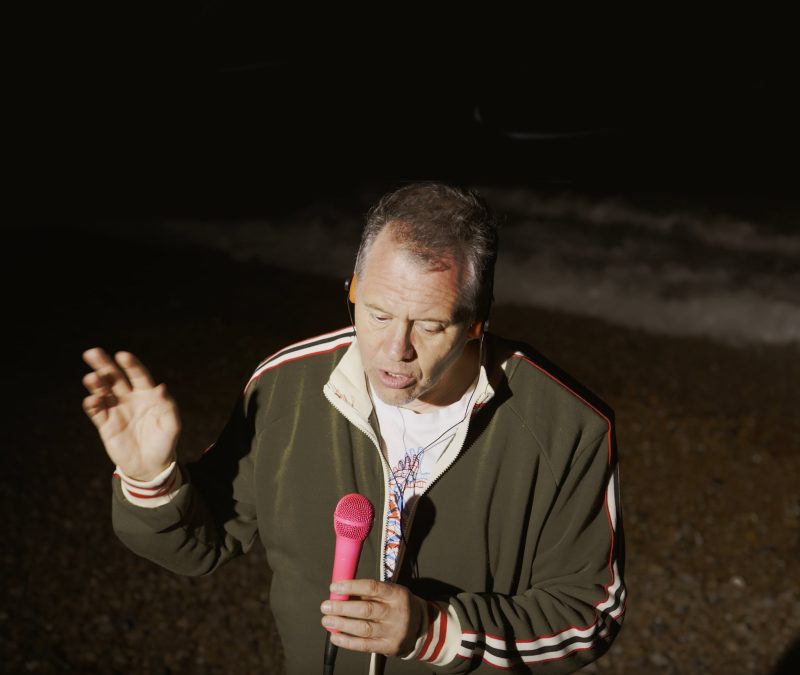
Amanda Gallagher meets Paul Mosley as the Hartlepool-born songwriter turns local folklore, teenage isolation and hard-won humour into his most personal record yet.
There is something gloriously Hartlepool about Monkey Hanger. After five years spent composing award-winning scores for puppet theatre, singer-songwriter Paul Mosley returns with his eleventh solo album and fifth with the Red Meat Orchestra: a record that takes a local insult, turns it inside out, and uses it as the doorway into a funny, restless and emotionally generous song cycle about identity, memory and home.
At its centre is one image: a teenage Mosley, around 17, spending a night alone on the beach in 1989, trying to “find myself” while also wanting to disappear from himself altogether. In the retelling, it becomes less a melodramatic coming-of-age scene than the sort of awkward, exposed moment that only reveals its meaning years later. “It sounds very heavy,” he says, “but at the time it was very underwhelming.” Still, the memory stuck, and eventually gave him “an album full of songs”.
The result is not a confessional record in the narrow sense. Monkey Hanger is too tuneful, too mischievous and too musically vivid for that. Across songs including 1989, Scooby-Doo, The Invisible, Captain I Confess and Lucky Dog (I’ll Remember You), it folds folk, Americana, jazz and chamber-pop into material that feels crafted rather than diaristic, while still carrying the charge of lived experience. “The type of music I like to listen to is music that comes from a personal space,” Mosley says. “That’s why it’s moving.”
For Hartlepool readers, the title lands with immediate recognition. The monkey-hanger tale has long been part joke, part stigma, part badge of defiant local pride. Mosley takes that tangled inheritance and makes it personal, using the phrase as a metaphor for shame, sexuality and belonging. “It was meant to be shameful,” he explains, “and I used it as a metaphor for sexuality and all of the things you can be called.” What emerges is not self-pity but ownership: “I am a monkey hanger and I’m proud. I am one of you, I’m gay, and you can’t not have me.”
That refusal to separate hurt from humour gives the album much of its spark. Mosley remembers his teenage self as someone who “just didn’t get it” — uncomfortable, embarrassed and unable to understand why he felt out of step, even with family and friends around him. On 1989, the memory of that beach-side teenage limbo becomes a kind of message in a bottle to his younger self. If he could send one line back now, it would be the song’s quiet reassurance: “Remember you’ll be alright.”
Where some songwriters might smooth those edges into solemnity, Mosley lets the jokes stay in. “I’m from Hartlepool and I can’t help it,” he laughs. “Our Hartlepool brains make a joke of everything.” That instinct runs through Scooby-Doo, a song that circles family misunderstanding and loyalty while giving itself a title that made him laugh, and through the album’s wider habit of letting sharp emotional moments arrive sideways. In Mosley’s hands, humour is not a distraction from pain; it is one of the ways people survive it. “It’s in our bones a lot of the time.”
Elsewhere, The Invisible deepens the album’s sense of adolescent disappearance — that feeling of moving through familiar streets and family rooms while somehow feeling unseen — while Captain I Confess leans into Mosley’s theatrical instincts, its title alone suggesting a character stepping forward to admit, perform or half-joke his way through the truths he has carried. Together, they broaden Monkey Hanger from personal reminiscence into something more dramatic: a cast of selves, memories and local ghosts circling the same shoreline.
Sonically, Monkey Hanger is richer and stranger than its back-to-the-past premise might suggest. The Red Meat Orchestra’s folk-and-chamber palette is stretched with jazz inflections, 80s analogue synths and the influence of improvising musicians Mosley encountered during years of international theatre work. Returning to a solo album after composing for the stage felt “a little bit of both” — like coming home, but also like beginning again. “I’m just writing for me and not for a brief,” he says. “But it has changed how I write… I’m definitely not the same person I was.”
That theatre experience gives the arrangements a cinematic breadth, from brass improvisations to kalimba, guiro, melodica, violin and odd percussive textures that make the record feel hand-built rather than polished to anonymity. Mosley describes the Red Meat Orchestra as a shifting family of trusted collaborators, including long-time players, his brother, and musicians gathered through particular projects. “The relationships with the musicians is what made it,” he says. “I trust them and they trusted me.”
The guest list underlines the album’s reach beyond its North East roots. Tom Moth of Florence & The Machine, Colin Smith, whose credits include Feist and Madness, and UK Americana favourite Elaine Palmer all appear, with Palmer’s husky backing vocals adding grit to first single Lucky Dog (I’ll Remember You). Mosley chose the track because it opens the door to the album’s emotional terrain without weighing the listener down: a song with enough lift in its step to carry the heavier undertow beneath it. “It’s a bit of a foot-tapper,” he says. “I wanted to talk about these things in a real way but not make it a drag.”
Mosley’s path to this point has been anything but linear. He first came to prominence as one half of acclaimed 2000s alt-folk sibling duo Moses, touring widely and appearing at festivals including Glastonbury, Green Man and Cambridge Folk Festival. His solo work later drew praise from The Quietus, Q Magazine, R2, Americana UK, Fatea and BBC 6 Music, while the folk-opera project The Butcher toured internationally and won acclaim at the Edinburgh Fringe. Monkey Hanger brings those strands together, but anchors them firmly back on the North East coast.
For listeners outside Hartlepool, the title may prompt curiosity about the town’s most notorious legend. For those from the town, it speaks to something more immediate: the strange power of taking a word once used against you and making it your own. Mosley hopes the album reaches both audiences, while also tapping into something universal about teenage confusion, isolation and the long work of understanding yourself. “Angsty teenagers can’t find themselves at the time, you kind of file it away as being oh that’s just what happens to you when you’re young he says. “Then when you’re older, you do go, no, it’s probably quite significant actually”.
In that sense, Monkey Hanger feels both like a homecoming and a step forward: a record by a songwriter with enough distance to revisit the past, and enough musical curiosity to avoid simply recreating it. From the scene-setting ache of 1989 to the wry family tangles of Scooby-Doo, the shadowy self-questioning of The Invisible, the theatrical confession of Captain I Confess and the open-hearted momentum of Lucky Dog (I’ll Remember You), the songs build a portrait of someone looking back without getting stuck there. “Definitely both,” Mosley says. “They are grown-up songs and the arrangements are grown-up, from someone who’s been around.” His hope is simple: that people listen once, then want to return. “I’d like people to go back and explore it some more,” he says, “so they can go, you know what, that’s a nice overview of getting through stuff, getting over your own past.”
In summary, Monkey Hanger is a sharply drawn, warmly eccentric album that carries Hartlepool in its bones while speaking far beyond the town: a record about shame transformed into pride, awkward youth reframed with tenderness, and the stubborn local instinct to meet even the hardest memories with a joke, a tune and a raised eyebrow.
Monkey Hanger is released 31 July 2026 on Red Crow Collective and is available to buy and download via Bandcamp.
