Narc. Magazine Online
Reliably informed


We talk deepfakes and AI with researcher in Artificial Intelligence Law at Northumbria University, who will be one of the panellists at the next Science Speakeasy at Newcastle’s Life Centre on Thursday 16th May
AI… We’ve read about it in the newspapers, seen it in movies and on TV, and we’ve even invited it into our increasingly smarter homes. It makes our lives easier, helps us plan our time and keep us feeling secure. However, there is a potentially darker and deceptive side to this technology.
Deepfakes are becoming more advanced and realistic and recent examples to have fooled the public include an engineered video of Barack Obama using obscenities to describe Donald Trump along with deepfakes of Putin and Zelensky, which were used as propaganda during the war in Ukraine.
These videos are seen by millions of people around the world and as a recent Royal Society Report (2022) discovered, a vast majority of people struggle to identify deepfakes from genuine videos. Also, the results of a recent YouGov poll found that 70% of MPs are concerned that AI-generated content will increase the spread of disinformation and undermine the integrity of the next UK general election.
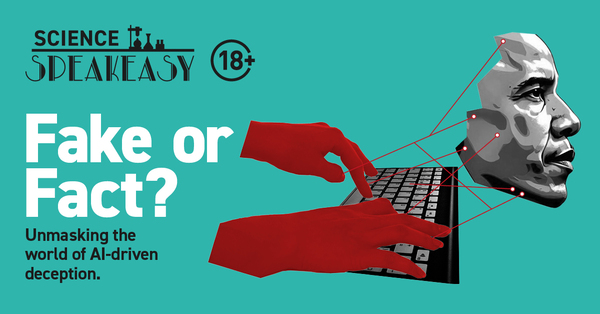
Fake or Fact is the next Science Speakeasy at Newcastle’s Life Centre on Thursday 16th May and will bring together a panel of experts looking to unmask the world of AI-driven deception as well as discussing the implications that this technology has on individuals, organisations and governments.
The panel includes Luke Chambers, a researcher in Artificial Intelligence Law at Northumbria University and social psychologist Daniel Jolley, who studies conspiracy theories at Nottingham University, with more panellists to be announced.
We caught up with Luke to find out more about AI, deepfake technology and the event itself…
In your opinion, how do you think AI has improved our lives? What future developments in AI do you look forward to?
AI has brought us a lot of fantastic innovations. On the entertainment and lifestyle side of things it has helped us to share knowledge, create art, and explore ideas. In healthcare we are using AI to diagnose faster and more accurately, discover new drugs or treatments, and respond quicker to emergencies. AI is also helping to prevent fraud, provide increased accessibility via assistive technologies, and make education more personalised.
In the future, I am particularly excited to see where art heads in the next 10-20 years. AI is already starting to write stories, produce images and video, as well as audio on the fly. Once this technology finds its feet, we could generate our own movies or TV series at home, just for us, based on our interests. I’m also excited to see AI applied to public needs, such as automated emergency crisis therapists for people in mental distress, or the translation of important cultural or religious works to make them available for everyone. I am excited for language barriers being removed in real-time too. With that barrier removed, education and friendship becomes unlimited anywhere in the world.
Science fiction films, TV shows and novels have given us plenty of warning about the dangers of AI. How seriously should we take these cautionary tales and which fictional tale best represents our potential future as a result of AI?
The ‘end of civilisation’ trope is great precisely because it’s such a real threat and is a recurring theme in human history, such as the Bronze Age Collapse. In the case of AI it could pose a major social or existential threat to society, but not in the way it’s often shown in the movies. It won’t be armed robots marching the streets with weapons and glowing red eyes, but software errors doing something like crashing the supply chain and causing famine, or accidentally inciting wars, or perhaps AI-enabled nuclear accidents or similar is realistic (but unlikely thanks to safeguards). In essence, if AI causes humanity to be in peril it’ll be because it enabled or accelerated existing problems – not because it became ‘self-aware’ or wishes us harm. In truth, it doesn’t ‘care’ about us either way. It’s powerful and sometimes dangerous, but inanimate. Like fire, or the ocean.
If I had to pick a fictional tale, in terms of ‘causes’ it would be M3gan in terms of corporate safety shortcuts and a lack of whistleblowing protection, or perhaps I Am Mother in terms of a powerful system misunderstanding the goals of a vague task and pursuing it relentlessly. In terms of consequences or ‘what happens’ then Black Mirror does a good job of exploring the less existential ways that handing over parts of society to AI can go wrong. Fortunately, Terminator and Matrix are far down the list!
Why do you think developers of this tech seem unconcerned by its dangers?
I think there are three reasons. Firstly, I think that the dangers aren’t always apparent. It’s not like other technologies such as airline safety or nuclear safety where when things go wrong they’re very visual, graphic, and public. AI causing danger can be much harder to see, much less visual, and gets less attention. Before I went to law school I was an AI computer scientist, and when creating AI systems you were typically trying to solve a particular problem. You were building a product. You often just didn’t think about all the ways your system could be misused, and you didn’t always hear if it had caused problems down the line.
Secondly, AI often causes harm when it is used inappropriately – which isn’t always down to the developers. You could create a flood prediction algorithm which works well, and you’re proud of it, but then if a hospital takes it and makes some tweaks to predict what care a patient needs, then it does a really bad job and causes innocent people harm – to what extent is that your fault as a developer? Developers can often see the impact as an ‘end-user’ problem rather than a ‘design’ problem.
Finally, there are just so few regulations that there’s no safety culture. In nuclear, or air transport, or defence, there’s a real safety culture ingrained into the companies, the people, and the profession. We just don’t have this in AI development yet, but it’s starting to get there in baby steps thanks to AI ethics professionals.
How do you think AI will impact the creative industries? Will AI ever be able to compete with a human’s capacity for creative thinking?
Predicting AI impacts is very difficult but in my opinion, the creative industries are about to undergo the greatest and fastest change since the Industrial Revolution. This is good and bad. It will make art much cheaper, faster, and easier to make. This means that a normal person can illustrate books, decorate homes, create business graphics, and even add music to videos and so on at next to no cost. This is good, but obviously it also forces lots of artists out of work which is bad. I don’t think anyone can accurately predict the long-term impacts of this, but disruption is likely to be good for some creatives and bad for others. People are going to have to adapt quickly. There’s certainly lots of worry in the artistic communities around this.
The saving grace though is that art is more than the finished product. Though business graphics, logos, infographics and so on may be easy for AI to make, actual ‘art’ says something to the viewer or listener and AI doesn’t really have anything to say. It can only copy. It will not be able to push boundaries of art, or truly communicate meaning. It might learn what people like and learn to replicate it, but this gets boring fast. For example, AI can (and has!) produced background audio for video games which is good filler, but would AI be capable of scores found in Lord of the Rings or Interstellar? I’m less certain. At least for now.
AI does not have emotion, culture, or intention. And so it can create pictures or paintings, but it can never truly create ‘art’ in the strictest interpretation of the word.
What do you think the main impact of deepfake technology has been on society?
I would say erosion of trust. We used to be able to trust what we saw and heard was real in most cases because faking something was very labour and cost-intensive. However, now that it is very easy to manipulate images, video, or audio it means anyone can do it for any reason – or no reason at all. We now live in a society where any bit of ‘proof’ can be a lie. We can be manipulated by fake videos but we may also distrust real videos. We are also starting to see this used for crime, especially fraud and in sexual harms.
How advanced will this technology get?
The technology is already fairly advanced in that it fools most people, however what might change is the speed. Instead of pre-doctoring a video or audio file, what if it could respond in real time? You could have a Skype or Teams call with someone and have a full conversation without realising it wasn’t your co-worker, but a fraudulent AI clone that is mixing deepfake imagery, audio, and large language models. Think ChatGPT with a fake face, voice, and accent. This is a decade or two away yet, but there’s no technological reason why this isn’t possible. When that happens, we may start to see preference swing back towards in-person communication. Or perhaps there will be equally advanced detection tools.
How is it being used for political gain?
Deepfakes are being used for political manipulation to make it look like candidates are saying things they are not. For example disparaging their own voters, or saying offensive things. This can be used to sway public voting in elections, or discredit political opponents. At present this is only being used by very disreputable parties but it may begin to seep into part of normal political culture.
How responsible have social media or pornography sites been in the development and widespread use of deepfakes?
Social Media sites and Pornography sites have not so much been responsible for the use of deepfakes as much as it is a case of not having the means or the will to crack down on them. How is a platform supposed to know, quickly, whether or not a video is real or not? There is detection technology, but it is reactive instead of proactive and is difficult to keep ahead of the ‘bad guys’. Surprisingly, the pornography world seems to be taking it more seriously than social media sites, but this may be because the sexual element adds more legal risk.
In the next few years, all online platforms will have to grapple with how they can make sure they are actively combatting deepfakes – even if this requires investment in expertise and tools.
Do any copyright laws offer protection to celebrities whose image is being used? Or has the legal system failed to keep up with the technology?
Law is famously contextual, but the broad answer is not really. There is some element of protection for deepfake pornography in that it is an offence to share sexually explicit deepfakes without consent, or threaten to share them, but that only counts for actually sharing the images. You can still make and keep them largely with impunity. For non-sexual images, there are very few protections offered under copyright or anywhere else because a lot of it relies on proving the intent of the creator which is very hard to do.
It’s not always the legal system failing to keep up with technology, though this is certainly a factor, but also the nature of the online environment. If someone makes a fake celeb video, and then tens of thousands share it believing it to be true – how can you find who originally made it? Even if the protections are there in defamation, harassment, privacy, intellectual property, data protection, or criminal law, they are useless if the nature of the beast means you can’t figure out who to go after.
How do we police deepfake technology to restore faith that what we see and hear on the internet is genuine?
This is a problem that in broad strokes requires a four-pronged solution: prohibition, detection, duty, and penalty.
We have to create laws which control what it is permissible to create with deepfakes and why, as well as making it illegal to sell deepfake software designed or marketed towards harmful purposes (prohibition). We have to create and invest in technologies to allow us to detect at least most common deepfakes (detection). We have to create regulations which mean platforms such as social media or pornography sites have to test media and remove any found deepfakes (duty). We also have to create laws which have realistic penalties for those found breaking these rules (penalty).
The law has already done this very successfully in certain other areas. For example, Section 7(7) of the Protection of Children Act 1978 makes it illegal to make indecent images of children no matter the method. This was done by making illegal ‘pseudo-photographs’ which includes computer manipulation. As a result, criminal law has kept firmly on top of harmful deepfakes in this specific area. This approach could feasibly be applied elsewhere, given the correct political and public will.
Fake or Fact Science Speakeasy takes place on Thursday 16th May. Tickets are available via the Life Centre website.