Narc. Magazine Online
Reliably informed

We catch up with Dynatron Galaxy’s funk-fuelled finest about their up coming weekend of science, sound, and stargazing in Hexham taking place 8th–10th August
Tune your dial to cosmic funk frequencies as S.K.X Funkanauts are here to groove your molecules and melt your misconceptions. This genre-bending collective fuse retro-futurist disco with deep space mythology, pulling funk, psychedelia and speculative storytelling into their orbit. More than just a band, they’re sonic world-builders and aesthetic engineers, treating each show as a transmission from an imagined interstellar civilisation.
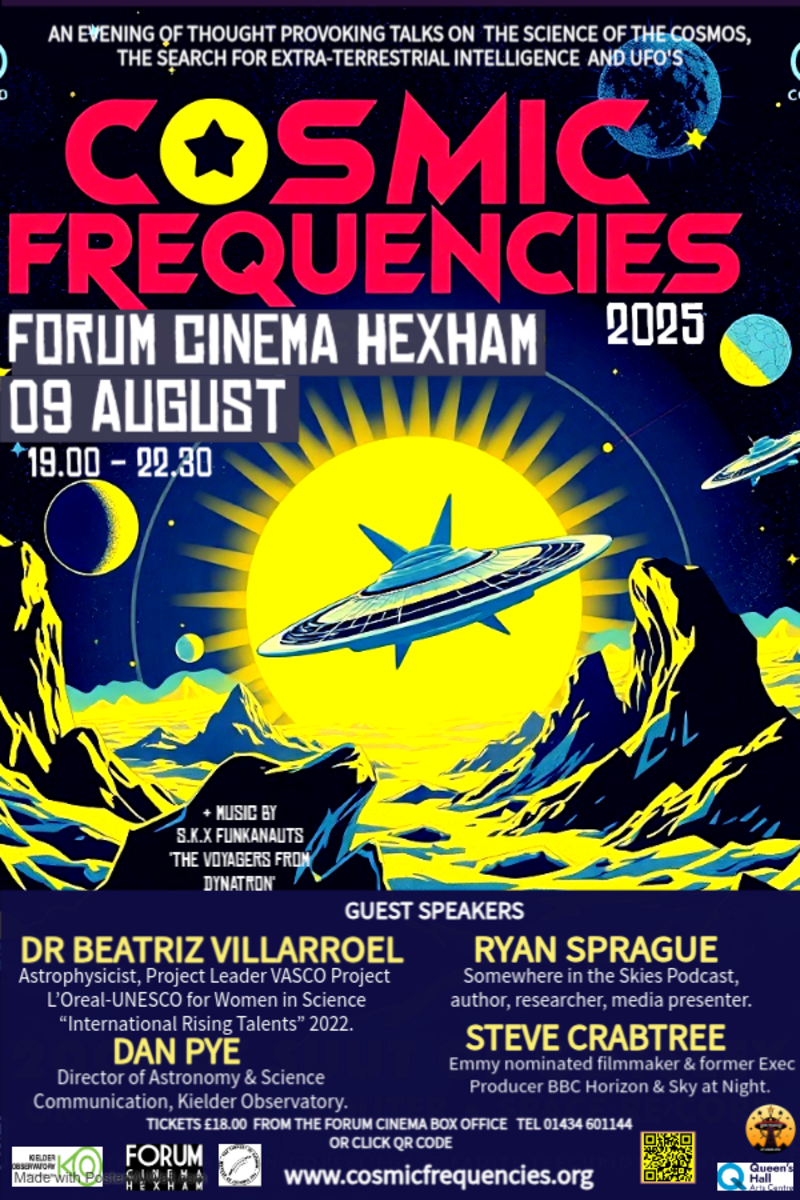
Now, they’re taking that vision off-world with Cosmic Frequencies Festival 2025—a three-day sci-art spectacular unfolding across Hexham from 8th–10th August. Co-curated with Kielder Observatory and The Forum Cinema, the event features an eclectic constellation of happenings: Friday’s Frontal Lobe takeover of The Tannery Pub reimagines the venue as an alien dive bar complete with a themed quiz, cosmic cocktails and a funk-laced DJ set. Saturday begins at Queen’s Hall with panels on sci-fi and special effects led by Neil Cole and Dr Bill Garrett, before crescendoing at Forum Cinema with a live performance by the Funkanauts themselves—intercut with talks from leading figures in space science, SETI research and UAP phenomena, including voices from Somewhere in the Skies, BBC’s The Sky at Night and the groundbreaking VASCO project. The weekend closes on Sunday with a communal screening of Close Encounters of the Third Kind.
Whether you’re an amateur astronomer, funk aficionado or sci-fi dreamer, S.K.X Funkanauts invite you to slip into orbit and recalibrate your sensors. This isn’t just a weekend—it’s a signal from the future pulsing out of Northumberland’s dark skies.
We caught up with the intergalactic music makers to find out more…
Cosmic Frequencies blends science, sound and speculative fiction—how did the idea for such an interdisciplinary festival first come about?
Cosmic Frequencies emerged from a creative and inquisitive approach to the themes embodied in the Festival. Along with the band, a group of fellow travellers on the S.K.X voyage found ourselves keen to bring like-minded people together to explore the intersection between science fact, science fiction in relation to the cosmos, whether we are alone in the universe through the lens of creativity and art. Historically, disciplines such as maths, geometry, astronomy and music have been entwined right back to the ancient Greeks. This helped us develop the idea to create a platform for these along with a place to nurture curiosity and discuss ideas on these themes.
Can you tell us more about the S.K.X Funkanauts and the sci-fi universe they’ve created—how does it shape the tone and experience of the festival?
S.K.X Funkanauts are a collective that, through the narrative of their music, imagery, words and stories, seek to shine a light on the big questions around humanity’s place in the universe and more importantly, how we are as a species on this pale blue dot. Their story, voyaging from Dynatron is essentially a play on what would an alien lifeform encounter upon arrival upon Earth? A planet riven with many ugly themes, yes, but equally one that holds great beauty in particular human art and creativity, this is the best of what we could show the visitor from across the universe. These notions, along with a sci-fi element, through the story shapes what the Festival is.
The Frontal Lobe at The Tannery Pub sounds like a playful entry point. How important is humour and imagination in making science more accessible?
This is vital to the ethos of the Festival and the Funkanauts. Whilst the themes may be serious, we seek to have fun too. This aspect is indeed an entry point to the wider aspects of the Festival. Using an aspect of the story of the Voyagers from Dynatron book, which combines humour and allegory, we hope people will have a good time through science fiction, whilst also dipping into the question of what is possible in science fact.
You’ve brought in speakers from astronomy, SETI and sci-fi fields—how were these guests selected, and what kinds of conversations are you hoping to spark?
Through contacts made by the band and fellow organisers of the Festival, Dr Nicole Skeltys and Dr Bill Garrett, we have been able to reach out to some significant speakers in their respective fields. We have targeted speakers who fit the ethos of what we hope to achieve through the festival. Regarding the conversations we hope to spark, we are very open and non-prescriptive. We aspire to make Cosmic Frequencies a vehicle for dialogue about some of the topics around space, UFOs and SETI, science and art, asking questions and perhaps seeking some answers.
What were some of the challenges in bringing together such different disciplines—music, space research, cinema—and making them work cohesively?
This is the first iteration of Cosmic Frequencies and so far we have found that all involved see the potential of it, have bought into making this year a strong start for future years, where we expand the programme. Perhaps a challenge is to get a healthy balance between the serious science and the science fiction elements. Though the great writer Arthur C Clarke believed that any serious scientist needed to embrace science fiction if they wished to be credible.
The festival’s location near Northumberland’s dark sky area feels symbolic—how does the landscape influence the themes or ambitions of the event?
Without a doubt this aspect is important to us. S.K.X Funkanauts have adopted Hexham as their home from home. In the voyagers story the Funkanauts land in Kielder so it’s an obvious and necessary thing. Cosmic Frequencies we believe is a unique festival for it to take place in the town that is the gateway to the dark sky park and Kielder Observatory is indeed symbolic. We have a vast space of natural beauty nearby and we hope to utilise this even more in the future with aspects of the Festival taking place at the Observatory next year. We hope that people will be encouraged to take the opportunity to go out into the dark sky park and look up to the stars. We believe that almost every human being on the planet through time has looked up at a starry sky and wondered what is out there.
Collaboration is key to this project. What has it been like working with partners like Kielder Observatory and Forum Cinema?
From the beginning of talking with both Kielder Observatory and the Forum Cinema they have been very supportive and engaged in both the vision and offering practical help. Whilst not speaking for them, we feel that they ‘get’ the concept, vision and intention. We hope they will go forward with us as we develop the Festival, which at the moment is very much driven by shared passions.
How does Cosmic Frequencies differ from traditional science festivals or music events—and what kind of audience are you hoping to attract?
The festival embraces and celebrates science and creativity perspectives equally; scientists researching SETI and UAPs are realising they have to work with academics from other disciplines such as consciousness studies, religious history and psychologists in order to find answers to such a complex phenomenon (as noted in Professor Bohlander’s recent submission to the House of Lords Select Committee on UK Engagement with Space). We acknowledge that and say human creativity as expressed through arts and music are just as important. Having fun with the big questions is vital! As for the audience, that is hard to say, we don’t think there is currently anything like it elsewhere, certainly not in the North East of England, but we know already people are buying tickets from all around the UK. We want a diverse audience of people who can find something to interest them across the themes.
With the first edition launching in 2025, is the team already thinking ahead to future iterations or other venues?
Yes definitely! We have started discussing 2026 and already have additional venues and ideas for content. We want more talks, a sci-fi short story writing element, more films, more music and more fun.
Finally, if you had to describe the Cosmic Frequencies experience in one phrase, what would it be?
Experiencing cosmic wonder through science and art!