
Narc. Magazine Online
Reliably informed

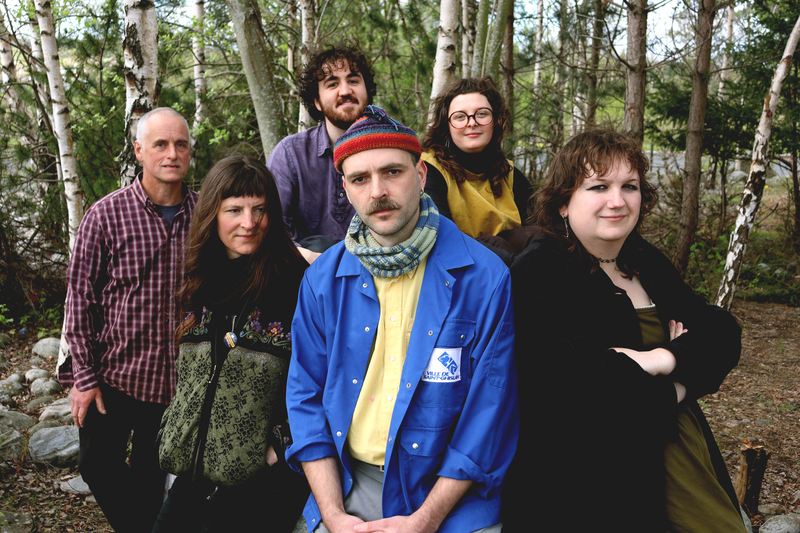
Lee Fisher went to the pub with Gus Beamish and Peter Bourne from Powtes for a long chat about sound games, collaboration and the political possibilities of the Fens re-flooding
There’s no doubt that folk music is having one of its occasional resurgences, with everything from the haunting pipes of Brighde Chaimbeul to the massed voices of Shovel Dance Collective getting some much-deserved traction. As always, Newcastle is punching above its weight in terms of folk, in many flavours – the old guard like The Unthanks and Cath & Phil Tyler and new voices like Jasmine Padgett and Ceitidh Mac. And now, after a long and fascinating gestation, the first Powtes album has been set loose into the world. And it’s a thing of beauty, although how folk it is (or isn’t) is one of the many things we discussed when I met up with Gus Beamish (songwriter, singer, guitarist) and Peter Bourne (trombone and pump organ) for a couple of drinks at the city’s folk bastion, the Cumberland Arms.
The album came out last month and this week there’s a rather special launch party (more details later). Destroying A Living is a set of eight ambitiously arranged, beautifully constructed songs, and it’s a concept album of sorts, dealing as it does with the enclosure of the Fens in the 18th century and the working class resistance it encountered. And if you think that sounds dry or academic, you couldn’t be more wrong.
The album is born out of frontman Gus’ fascination with Marxist politics, East Anglian folklore and community resistance. Growing up in Bury St Edmunds, his first musical explorations were in the tape underground/early internet harsh noise scene, and he was used to creating sounds for club spaces. “As a teenager, I was really locked in and obsessed with that and did lots of trading emails with random Italians in various different squats, doing split tapes with them and stuff.” Gus explains. “It was just great, just lots of forums, lots of message boards, chatting to people, doing stuff, I did a few house shows, terrorising all of the other teenagers with brutal ‘no input’ noise mixer sessions. Since then, I’ve played in lots of different bands and various solo things, but nearly all electronic and nearly all sort of club focused. I’m in a band called Makeness, which is post-punky and electronic. there are electronics involved, but it’s not primarily electronic. And through that I met someone called Kyle, who was sort of like the main songwriter for that band when I got involved with it. And we started making club music together and putting on club nights.”
Despite the club leanings of his early output, folk has always been important to Gus. “I’ve always been really into it, but I’ve never been super into singer-songwriter stuff, really. I’ve always been more drawn to folk traditions where there’s a kind of implied psychedelic experience in there. Lots of repetition, lots of drone, all of those sorts of things – like Sardinian music and lots of traditional Irish music as well. I got really obsessed with various forms of Scottish piping for a while. That’s kind of shared obsession between me and Kyle. We used to listen to Pipeline, which was the BBC Alba pipes show. Just like an hour of piping presented by a very softly spoken man… we saved them up if we knew we were going to be going on a long trip. ‘We’ve got like 6 hours of driving – well, we’ve got 5 Pipelines in the bag!’ And I just slowly got more and more obsessed”
Running concurrently with this, Gus was also becoming fascinated with the drainage of the Fens in the late eighteenth century.
“It’s been a pretty long term obsession.” Gus admits. “Suffolk is such a sort of bleak and gentrified place. I mean, there’s pretty things around, but culturally it just felt really dead. And I was ‘why are there all these amazing folk traditions in other parts of the world or other parts of these islands? But there isn’t one in Suffolk really. Like what happened there to make it different to what happened elsewhere?’. My parents were really into folk music but there was never any traditional Suffolk or Norfolk or East Anglian folk music being played. The exception being sort of novelty acts, which are great, like the Kipper family. And then obviously, like all righteous young people should, I got radicalised, became a staunch Marxist and got very interested in the processes of enclosure. As a result of that, reading those later chapters of Capital about primitive accumulation as a teenager, I was thinking ‘Oh my fucking God. this is what happened all across the country!’ and got more interested in finding out what its particular dimension was in East Anglia and in the Fens. And it’s just a really interesting case, because (the enclosure) was so late compared to quite a lot of the rest of the country. It was enclosed in a very different way, very rapidly, much more totally. and the resistance to it, because it was so rapid and so total, was so much more directed and organised and violent than in other places…”
In a way, I would be really happy if it had no appeal at all beyond just Newcastle, just a band for 0.01% of the city
Gus explains that while his fascination with all this has something to say about the world we find ourselves in now, “… it’s always a bit of a tricky one because I don’t want to get into this kind of like nostalgia chamber, about how there ‘used to be real resistance to capital and this is what it looked like.’ It’s more it’s more that I felt it was quite an underreported or not deeply celebrated tradition… And it’s also a weird opening into really divergent things about what our occupation of this island could look like, because lots of people were living pretty weird and free lives. There’s something about the marginal nature of it. Also, the fact that it’s going to be flooded again. And that kind of contains its own kind of horror, and its own kind of euphoric potential.”
The music and the political history sides of Gus’ thinking started to cohere when, having been forced out of London, Gus and his partner Katy found themselves staying with friends on a semi-collectivised farm in Chile. Denied his usual electronic kit, he started playing around with a borrowed guitar – taking part in jams, writing basic songs built on drones and intervals. “And at the same time, I was writing a novel about this weird period of enclosure and then a projected weird future where the fens are re-flooded and an anarchist collectives come to reclaim the land and it’s like brief moment that everyone’s able to survive There’s one song on the album that’s set in that world, which is Green Afterglow.” (The novel isn’t finished but it still exists, so there’s hope is may appear one day…)
Arriving in Newcastle, Gus realised that he needed to find a musical community like the one he’d found so nourishing in London. “And these songs seemed like a good way to be able to do that. I asked anyone that I met if they were interested in playing with these songs, I was like, ‘they’re open structures, you can play around with them’ and I gradually sort of persuaded people.”
Peter and Gus first worked together through collective studio happenings and sound games. “We were both interested in music making using open-ended, rules-based scores,” Peter explains, “although it became something very different. But the two of used to meet quite regularly to talk and plan.” “We were doing little workshop things to get people to come and try the scores out.” adds Gus.
Gus explains that he didn’t have a shopping list of instruments he wanted (“it would be weird if you’d been, like, ‘we need a trombone’” says Peter). But eventually the band settled into its current six-piece form, with Gus and Peter augmented by Phil Tyler on fiddle and mandolin (cue a discussion about possible bylaws requiring Phil to be a member of ever Tyneside folk band), Katy Sillem on flute, penny whistle and vocals, Frankie Insley on fiddle and Cajun accordion and Emily Toth on harp. Peter comes from a classical background, working as a piano teacher, and found working with Powtes very different. “Our approach to playing together in person initially was that we’d just play the songs over a few times and try different things out and then eventually certain structures and certain things stuck. And also performing them live together really shaped it, I think… When we play live, I kind of have to be the bass most of the time. But on the recording, I can do the bass and then we can layer up other brassy parts, things that don’t really make sense to do live.” “It would be good to have a 30-piece band”, adds Gus, with a cheeky look.
The gestation of the album was a long one. “This is by far the longest I’ve ever spent on anything.” Gus explains. “With my stuff that was club oriented, I build my setup and then just do a live run and a little bit of editing and then that’s the tune. And if it works, it works, it doesn’t work, put that one in the bin onto the next one…” The band spent around eighteen months playing the songs before recording them, trying different approaches and motifs, exploring possibilities, letting the musicians bring their own personalities. Recording was done in front rooms in west Newcastle and things were wrapped up around March of this year. Then Gus spent time editing together everyone’s parts – sometimes there were fifteen takes.
The Powtes sound is hard to pinpoint – I’ve occasionally resorted to ‘chamber folk’, but Gus and Peter aren’t convinced. “I think we’re a bit less purposeful than that,” opines Gus. “slightly more rough-hewn and incidental.” “I usually say droney folk”, Peter chips in. “It’s because it’s not actually folk music.” Gus interjects. “That’s the thing. It’s more just like post-rock, but we don’t use any electronics. There are bits that sound a bit like Godspeed You! Black Emperor.”
Gus admits that he has modest aims for Destroying A Living. “It’s like a nice small thing that we do together. In a way, I would be really happy if it had no appeal at all beyond just Newcastle, just a band for 0.01% of the city.” It seems unlikely that’s what will happen, because Destroying A Living is one of the most powerful, unique and straight-up beautiful releases to emerge from this city for quite some time.
Powtes’s Destroying A Living is available on Bandcamp now. And they play a special launch party show on Friday 4th September at the Star & Shadow, with support from Jasmine Padgett Family Band, Nev Clay, Worms and a yet to be revealed special guest.
