Narc. Magazine Online
Reliably informed

Lee Fisher enjoys a series of wide-ranging performances celebrating the composer’s 90th birthday
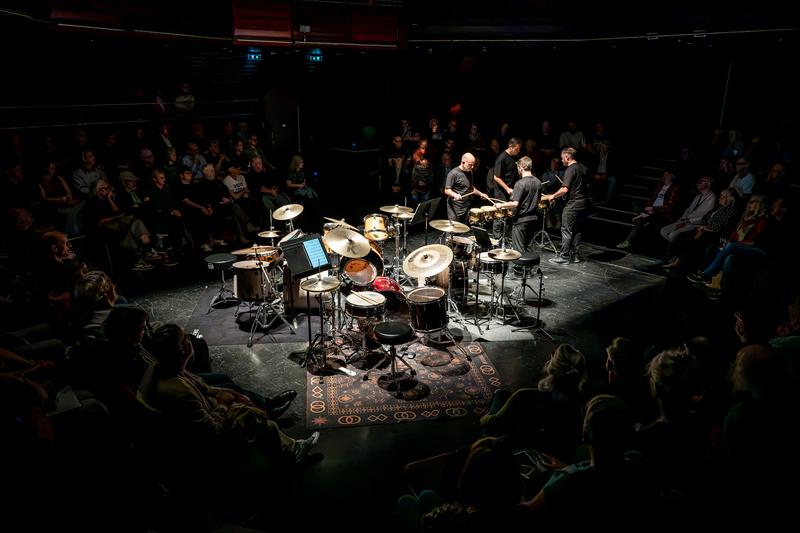
Image: Drumming Part 1 by Thomas Jackson
This weekend of Steve Reich performances at The Glasshouse wasn’t the only celebration of the man’s birthday but it was one of the most impressive and wide-ranging and it was a thrill to see it being hosted down by the Tyne. Curated by Reich collaborator Colin Currie (who also variously conducted and performed across the weekend in various incarnations), the programme included works from the 1970s right through to the 2010s.
After a talk on the concourse with Radio 3’s Tom Service, Colin Currie and a fellow percussionist kicked things off in Hall One with a performance of Clapping Music (1972) and in many ways, this small, simple, mind-blowing piece is the most significant of the weekend, containing the germ of so much of Reich’s work. The two men clap out the same 8/12 rhythm in unison before one starts to begin to skip a note or beat, throwing the sounds out of phase, until eventually the rhythms slip back into synch and the piece ends. The concept was to take Reich’s tape experiments with phasing and apply it to just hands, and it’s such a brilliant, hypnotic idea that it’s a marvel to see it performed live, wondering as ever how the hell they do it. The other three pieces in this show – Runner (2016), Double Sextet (2007) and The Desert Music (1983) – share a similar sonic palette with excellent results. Runner is as propulsive and pulsing as the title suggests, while Double Sextet (featuring, obviously, two identical sextets interacting) plays with overlapping and interlocking rhythms, strings almost battling. The programme closer was The Desert Music, a powerful and genuinely alarming work for a ~40-member incarnation of the Royal Northern Sinfonia, including a rousing ten-part chorus. Desert Music was Reich confronting the horror of the nuclear age and it’s as unsettling and anxious as that suggests, recalling nothing so much as the score for Beneath The Planet of The Apes in its discordant, fearful passages. Hugely enjoyable yet so troubling it’s almost a relief when it’s over. As a side note, this is the first fully orchestral programme I’ve seen in Hall One and I finally understand why this magnificent mirrored slug by the river has such an amazing reputation.
A fair proportion of the Hall One audience then decamped to Hall Two for a much more intimate affair, featuring Colin Currie leading his percussion quarter. With the quartet playing in the round, they began with Drumming Part 1 (1970), which feels very much like a development of the ideas in Clapping Music – each drummer playing two mounted, tuned bongos, again shifting and altering the patterns, dropping out for a few bars before coming back. It’s hypnotic and captivating and once again you wonder at the degree of focus and discipline needed not to mess it up. This was followed by Dark Full Ride (2002) by Julia Wolfe, an attempt to marry the ideas of Reich with the dynamics of rock drummers, with the quartet each at identical stripped-down kits. The first part was marvellous, the hypnotic cymbal rhythms calling to mind Nissenenmondai or Boredoms. The latter part, when the drums are introduced, felt a little less focussed and if it was being played out to a careful structure, the maths involved were beyond me and it felt weirdly messy. A lot of entrancing fun nonetheless.