Narc. Magazine Online
Reliably informed

We catch up with the Newcastle‑based psych trio on the back of the release of their world exploring debut album
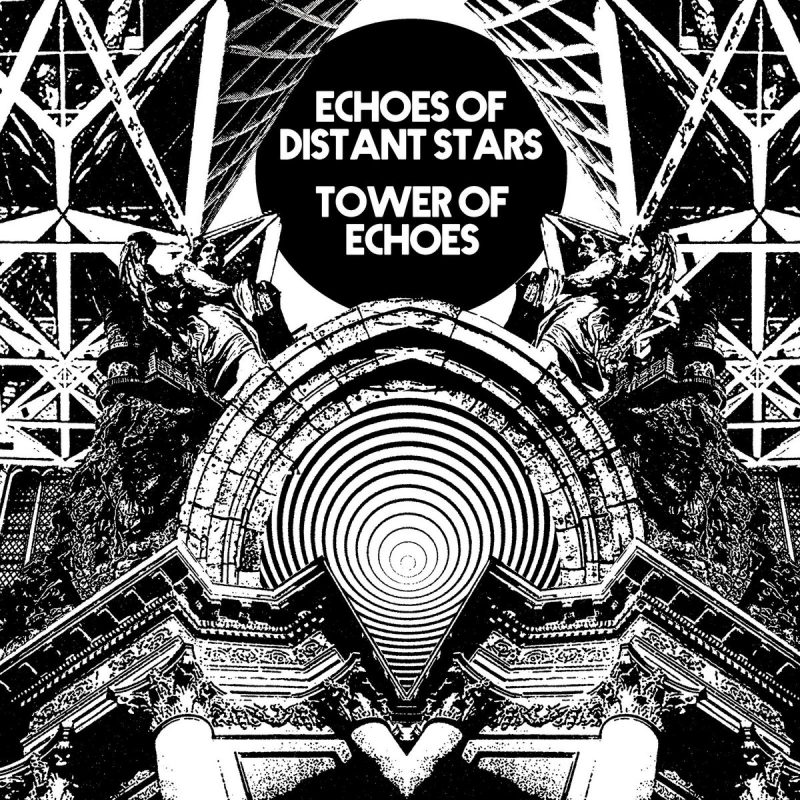
Echoes of Distant Stars are a Newcastle‑based trio channelling kosmische drift, prog heft and psych‑folk haze into sprawling, semi‑improvised voyages. Across their debut album Tower of Echoes, they dive deep into two 21‑minute worlds: Anomos, a harsh, ghost‑ridden landscape of rock and sand, and Archon, a shadowed realm of myths and secrets circling the Tower itself. With thundering drums, melodic bass lines and fuzz‑soaked guitar spirals, they pull you into a heady, cinematic trip through space.
We caught up with the cosmic explorers to find out more…
How did the band come together?
We’ve been playing together for about a year and a half now. Alex has been playing improv psych for over ten year, and I’ve been making music with him since around 2023. When Dave joined, we started moving into the sounds and composing style that makes Echoes of Distant Stars.
What inspires your music?
Firstly, and in common with all bands (I hope), the inspiration comes from wanting to make noise in a room with mates. The social/creative activity of it is, for me, first and foremost. It’s the purpose and the inspiration for making music. The real fun – the inspiration – of improv is that work to try and get on the same page, in the moment, from nowhere. Knowing that it doesn’t always work, knowing that, even when it is working, it could all fall apart in a second with a bum note (realising that not all bum notes are a catastrophe… I play more ‘wrong notes’ that right notes); that’s a really inspiring space to be in.
I’d also say an inspiration to me is meeting other band, hearing the music they make, seeing their merch, the ideas, the influences, the stories, the places they’ve played. It is a real inspiration. We’ve been lucky to play with some great bands, but even luckier – and something that certainly sparks more inspiration – to play with some really nice people; people doing sound in venues, venue owners, audiences. It’s something that, by and large, is a really positive feature of the psych scene.
Musically – so many bands and albums. Alex has one of the most comprehensive knowledges of music, and is forever sending great album on the group chat. He also compiles playlists that are literally weeks long! So we’re always adding to our musical influences… more on this later!
In terms of all the extra-musical stuff – the writing, the concepts of the planets etc – I’m really inspired by soft science fiction like Ursula Le Guin (Always Coming Home being one of the best things ever made). Also Jorge Luis Borges… there’s quite a lot of his influence in the idea of the Tower of Echoes on Archon.
What draws you to creating long-form, semi-improvised pieces instead of traditional song structures?
Well, in the early days, we would entirely improvise without any pre-composed material at all. We’d pick a starting note, and off we’d go. But actually, that total freedom – the completely blank canvas – can actually be quite limiting. And so, when you can do ‘anything’, I think we found that we were kind of doing the same thing each time. So Dave really inspired more of that composing and rehearsing pieces way of doing improv, and we’re really finding it a rewarding way to make music. Actually, the first time we played an improved piece for a second time came about by a technical error! We always record everything we do in rehearsal, but the recording device didn’t work when recording one, totally improvised, piece of music. If you look at the Bandcamp, the first iteration of Anomos is called The Lost Echoes Of… This is us trying to remember the first version of it that we ‘lost’. And from that point, I think we found having at least an idea – a riff, a melody, a rhythm, a vague structure – to work around a really liberating thing. It’s like we had an anchor point to keep returning to. What we did with both the tracks on the album – but especially Anomos – was continue to improvise around these fragments of ideas. What happened was that we crystallised the different parts that make up the song, but also, each time we’d drift off into ‘new’ improvised parts. Some of these bits get forgotten, some make it into the constellation of fragments that is Anomos for the next iteration. So there’s always this ‘expand and crystalise’ process that’s going on with the improvisations.
Tower of Echoes imagines entire worlds; how do you approach building those sonic landscapes without using lyrics?
The ‘imagining of worlds’ aspect of Echoes came retrospectively actually, as a way of reflecting on the semi-improvisational recordings we were doing. I started thinking of each of the pieces as existing as external objects, and that each time we recorded them, we were observing that object, and collecting partial data. Imagining bits of melody that were, by now, coming into focus, as ‘landmarks’, or structural things like dynamic changes as geographical features, it made sense to see the tracks as planets. And then, each recording became like a different data set, observing the planet. Each time, there would be landmarks, features and relationships between them that would be familiar, but the weather might have changes and make them look slightly different. Or a new part of the landscape might be explored. So that’s how the imagining of Anomos and Archon as planets came into being. It was then thinking about what those worlds would look like (if they sounded the way they do), which then became a bit of a circular creative process; leaning in to the idea of Anomos being a planet of black and white, of harshness and ghosts.
Though we don’t have ‘lyrics’ as in vocals on the tracks, the two worlds were certainly formed from writing as well as music. The album has a complementary notebook that comes with it (still a couple of copies available!) that maps out some of the ‘xenographies’ of the planets.
The album splits into the harsh world of Anomos and the myth-haunted realm of Archon; what connects those two spaces for you?
Myth-haunted is a great phrase; I’m nicking that!
It’s a very good question…
Partly, they are opposite sides from one another (literally, obviously). But literarily, Anomos is about binaries, the black rocks and white sands. It’s about ghosts and apparitions. Where Archon is about half-truths, multiple truths and a space where myth seeps out of the soil.
But musically, they are actually pretty connected, pretty close. We came up with these two pieces at the same time; they really represent the first development of Echoes. And we wanted to have an album that was two full-length songs, so they both developed musically in a very similar ways.
How do you balance spontaneity with structure when performing 21-minute pieces live or in the studio?
This is one of the more difficult things about long-form improv really – that balance of the composed and the improvised. But really, that is what improv is all about; balancing different contrasting elements. So it really it’s always happening, but it’s happening across a lot of different axes all at once. Balancing listening and playing is a really important one, leading and following; it’s always a game of listening to where the other performers are, where they might go next, where you think you might go next, what middle ground might be reached, can you convince the others to come along with you, or do you have to change your mind and follow their lead. Do you want to stick wit the little riff or idea that you’re developing, or move on to something different. It’s all happening in real time with improv, and I think that’s what we really love about it (hopefully what people who listen to us or see us live respond to as well).
Often with improv, spontaneity comes by accident. As an example, we’re working on a new track (Fyrgengat… which you can hear on the bandcamp in different iterations). We’d developed the main melodic idea, the sort of feel of the song. On the most recent recording, as happens with alarming regularity, I snapped a guitar string, which pulled the guitar out of tune, and meant I couldn’t really play the second part of the song. Dave and Alex picked up on this though, and changed to a new section which we’d never thought of before, which has given a totally new dimension to the track, and really made it come alive. So I think leaning in to accidents, listening to the directions other are going in, and balancing noise/silence, repetition/change, familiar/new, melodic/atonal, are all things that make improv work, and make it fun.
You pull from kosmishe, prog, psych and folk; how do those influences shape your sound while keeping it distinctly your own?
Again, I think like all bands, we come at music from different influences, and our Venn diagram overlaps somewhere around what we sound like!
The long-form, concept-driven tracks are really inspired by prog and psych – again a list of bands that are so long it’d be hard to scratch the surface here. The folk music influence adds some of that melodic influence.
But we’re always adding new things to the playlist. And all of those new sounds add to the influences we’re taking…
This is all leading up to me defending my love of Cliff Richard… which I get a lot of stick for. But I stand behind ‘Wired For Sound’ as one of the great albums. And that diversity of listening is what makes us ‘distinct’… whether that’s a good thing or not!
Your music feels fluid and ever-shifting; how do these long pieces evolve on stage from night to night?
Live performance is slightly different from the live recording that we do, but it still forms part of that rehearsing-improvising-crystalising process. And live performance is a great place to gauge what works with audiences as well. I tend to have hair in my eyes (or my glasses have flown off), so I don’t really see what’s going on when we play live, but Alex and Dave are always looking out at the audience, and when you’ve got a room of people, eyes closed and nodding their heads, you know you’re doing something alright. So that helps us shape the direction of the piece in the moment of playing, feeling some of that energy and letting that bring the songs up, or bring them back down. But it also helps us bring new ideas into recording as well.