Narc. Magazine Online
Reliably informed

Lee Fisher returns to the Glasshouse for day three of the venue’s celebration of Steve Reich
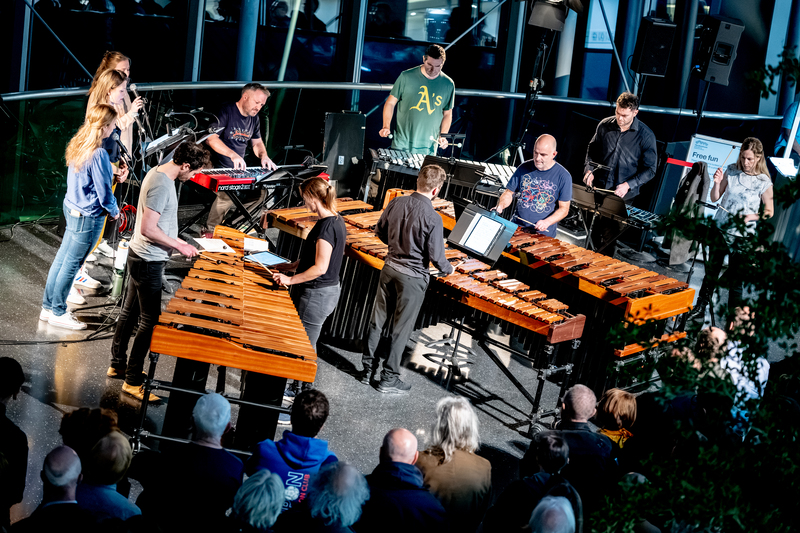
Image: Music For Mallet Instruments, Voices & Organ by Thomas Jackson
Other commitments mean I missed the second day of this Steve Reich weekender – his actual birthday – and that meant missing Music For 18 Musicians (the ‘hit’). There’s a stream here if you want to see it, it seemed very good.
Meanwhile, back on the bank of the Tyne for day three, and most of the milling audience seem familiar from Friday (if a little more hungover and depleted). The first stint was in Hall Two, and consisted of four pieces from National guitarist/composer Bryce Dessner and a performance of Different Trains. The Dessner pieces were a mixed bag: Garcia Counterpoint (2015) was a solo piece from Dessner, an attempt to mix the style of Reich’s Electronic Counterpoint with Jerry Garcia from The Grateful Dead. This is a terrible idea. The Grateful Dead were terrible, nobody needs this, and the piece was just fret-noodling. Ahyem (2009) and Tromp Miniature (2024) were more interesting, performed by members of the Royal Northern Sinfonia, while Morder Ballades (2013) was perhaps the best of the bunch, in particular the movement that had a more urgent, percussive energy and hints of an Anatolian melody. The afternoon performance was finished off by another cornerstone of Reich’s work, Different Trains. Performed by an RNS quartet against Reich’s recordings of train sounds and interviews first with American rail workers and travellers, and then holocaust survivors. It’s powerful stuff, the strings following the rhythms and intonations of the spoken snippets as they repeat. The piece is anxious, jittery, draining.
Phase/Pattern/Pulse was an installation running through the weekend in the Northern Rock Foundation Hall and it was a rewarding hour. As the audience settle onto chairs or a few beanbags, Reich’s music is played on a 360° sound system and lights oscillate and shift. It wasn’t quite a Pink Floyd laser show at London Planetarium but it was still entrancing, perfect for deep zoning in what felt like a cross between the chill-out room at Shoom! in 1989 and the liminal space in Under The Skin where Scarlett Johansson eviscerated her victims. It’s amazing what you can do with a fantastic PA, a bunch of spots and a whole load of smoke.
The closing main event in Hall One was a quartet of pieces, mostly using the full force of the BBC Scottish Symphony Orchestra, conducted by Colin Currie (who is an animated, relentless force of nature, playing or conducting almost everything we heard across the weekend. Three Movements (1986), Variations For Winds, Strings & Keyboards (1979) and The Four Sections (1987) all focused on different aspects of the orchestra with powerful results, the closing Four Sections in particular positively throbbing with energy and intent. Against this, I’d have to say that the returning Bryce Dessner’s take on Electric Counterpoint (1987) (y’know, the Orb sample…) was a disappointment: there was a shimmer and flow to Pat Metheny’s original that was missing here. While impressive, Dessner’s playing felt jerky and staccato by comparison.
In a pleasing symmetry, given that the weekend started with the still remarkable Clapping Music, perhaps the loveliest performance of the whole weekend was the very final one on the concourse. Music For Mallet Instruments, Voices & Organ (1973) saw the expanded Colin Currie Group playing eight mallet instruments (marimbas, glockenspiels, metallophones) alongside an organ and two female vocalists. It uses many of Reich’s more familiar techniques – repetition, phasing, shifts in duration – but is also just incredibly beautiful. The perfect marriage of maths and melody. It’s a gorgeous way to end a richly rewarding weekend.