
Narc. Magazine Online
Reliably informed

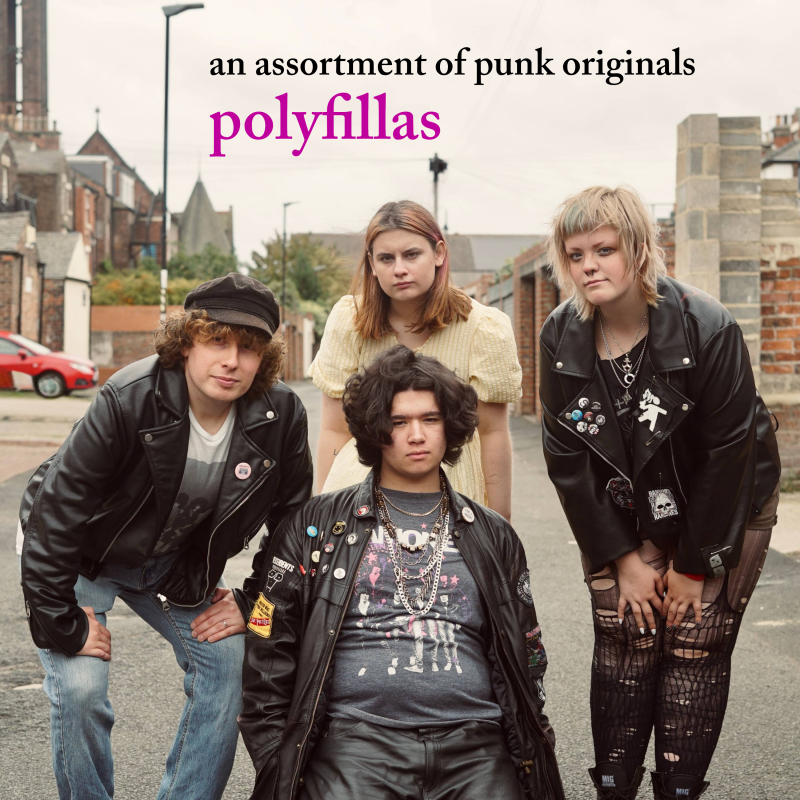
We caught up with the Sunderland’s rock ‘n’ roll quartet as they release their debut album, an assortment of punk originals
Sunderland four‑piece Polyfillas, formed by partners Ava and Jamie Dangerous and later completed by fellow couple Liepa and Dennis, have spent the past three years gigging nonstop while evolving from stripped‑back acoustic beginnings into one of the region’s most exciting punk‑leaning outfits, now arriving with An Assortment of Punk Originals, a debut album two years in the making.
Sonically, the album is an explosive riot complete with crunchy, bouncy punk chaos powered by frantic drums and growling riffs, with Ava and Jamie’s attitude‑soaked vocals either tearing through tracks solo or colliding together on songs such as Own Youth Movement. Moments like the organ drop‑down in Grampa Joe, the skanky indie swing of Period Pain and Rude Boys of England, and the rhythmic punches in I Like Your Underwear keep the record shifting shape and staying fun and exciting.
We caught up with the band to find out more…
An Assortment of Punk Originals pulls together punk, folk, reggae, dance‑rock and riot‑grrrl energy; how do you pull together such a varied mix to feel cohesive?
I don’t know, to be honest! It just all somehow comes together. It’s nominally a punk album in both style and content but it has all these different threads to it that pull in all sorts of interesting directions. Me and Ava have always been impressed by artists who can push the envelope within their own genre, territory or style, and I think that’s what we’ve tried to do on this album. I think it succeeds pretty well.
Who are some of the artists who have inspired the band?
Some of the big ones include the Clash, the Ramones, the Libertines, Bikini Kill, X, the New York Dolls, Neil Young, the Replacements, the Libertines, X-Ray Spex, Bob Dylan, the Velvet Underground and Amyl & the Sniffers. I could go on and on and on. We all listen to lots of different types of music – not just punk – and that has certainly shaped our sound. But the type of music we play is very much informed by the attitude, feel and flair of those artists in particular.
When the project started with Ava and Jamie, the early songs were acoustic. How did that period shape the band’s current sound?
The songwriting mainly. Basically, we’ve always been a song-orientated band, as opposed to a riff-orientated band or a groove-orientated band, although we do have plenty of those as well. So our attitude and approach hasn’t really changed, even when we were just doing things acoustically. Of course our sound has changed a lot – that’s the difference cranked-up electric guitars and a crack rhythm section can make – but our songwriting approach has remained more or less the same.
How did Liepa and Dennis joining in 2025 change your sound, writing process and live dynamic?
Before Liepa and Dennis joined, we had the songs, creativity and attitude but we sometimes struggled to play in time with each other and things would often fall apart quickly. That’s no disrespect to any previous Polyfillas members – it’s just an enormous compliment to Liepa and Dennis, who have somehow made the whole thing gel for the band. Liepa is a hard-hitting drummer who can also play fast when she needs to, and Dennis is a highly intuitive bass player who always knows what to play. They both keep the ship steady when Ava and Jamie are rocking it everywhere. Which happens quite a lot!
How does being a Sunderland band inform your sound, attitude or storytelling?
Even though Ava is the only member of Polyfillas who can actually claim to be Mackem born and bred, we are all closely tied to the city and its music scene in particular. Our album was recorded in full at the Bunker. It’s an amazing little grassroots music venue, rehearsal space, recording studio and music tuition space here in Sunderland. It’s where Ava and Jamie met in 2022 and actually formed Polyfillas. So if it wasn’t for the Bunker we simply wouldn’t exist! But Sunderland as a whole has a really, really exciting music scene at the moment. Bands are springing up everywhere, sometimes with members as young as 14 or 15, which is so encouraging to see. It’s a very exciting time (and place) to be alive. I think the close-knit nature of the Sunderland music scene has definitely helped us form close bonds with other musicians and our audiences. Which in turn has surely shaped our sound, style and attitude a little bit.
Tell us about An Assortment of Punk Originals; what are some of the themes that run through the album?
It’s a punk album, no question about it, but it’s also quite eclectic and isn’t afraid to push envelopes. Lyrically, it has quite a few moments which deal with wider issues – racism, sexism, period poverty, disenfranchisement with the current political order and lack of opportunities for young people. Not all our songs are that serious or political-minded though. In fact, just as many are humorous, laced with irony, self-references and contempt for anyone who doesn’t like us. But even in those moments – especially in those moments, in fact – you can always find some pointed social commentary, wry observation or subtle truth which will resonate with a few listeners. I hope.
You’ve spent the last year gigging nonstop; what parts of your live show were you most determined to bottle on the record?
The energy, chaotic spirit and looseness of it all. We didn’t want to take out the ragged edges or compromise our naughty lyrics. We’ve preserved the spirit of our live performances on record, but we’ve also added a few studio tricks, zeroed in on the lead guitar and scattered a few keyboards across the album. Our producer Phil was really the guy who made all this possible. I think doing this has opened up a few more avenues for us and given some of the songs a more post-punk swagger. It has also given us the confidence to take more creative risks going forward.
The album took two years to make. What actually stretched that process out, and what moments or challenges along the way ended up shaping the record into what it is now?
Money, mostly. We couldn’t afford to bash it all out in one go, so we kept going back, two songs at a time (except for Rude Boys of England, which took a whole day to record as it’s quite a bit longer than the other songs.) Although this approach to recording was frustrating for us to begin with, it’s actually been a blessing in the long run. For starters, the lengthy process allowed us to really determine which songs were going to make it on the album, and which weren’t. We really had to choose the cream of our crop, so to speak. We’ve also become a lot more confident and loosened up as musicians these past two years. Some of our songs really needed to be performed “live” in the studio (as opposed to endless overdubs) and it’s only since Dennis and Liepa joined that we’ve really felt loose enough to record that way. Finally, if we’d completed the album at an earlier date, we’d have most definitely rush-released it without even bothering to do any promotion, because that’s how you do things when you’re young, impatient and starting out!
What’s next for The Pollyfillas?
A9: We’ve got a lot of gigs this September. 5th is Vixen Bar, Hartlepool. 11th is Amped Up, Stockton. 18th is Downcast, Gateshead. 20th is Zerox, Newcastle. Then in November we’re playing Diegos in Sunderland. But in terms of the long term, who knows? I guess it sort of depends on how people respond to this record. I don’t mean whether people like it or not, but whether it generates a feeling of urgency and excitement. I hope it does. Then might start playing further afield, taking our message outside of the north-east. We still have quite a few unrecorded songs and unrealised ideas, and whatever happens we’ll definitely be composing some more. But in all honesty we haven’t thought that far ahead yet. Let’s see how this album goes down first.
