
Narc. Magazine Online
Reliably informed

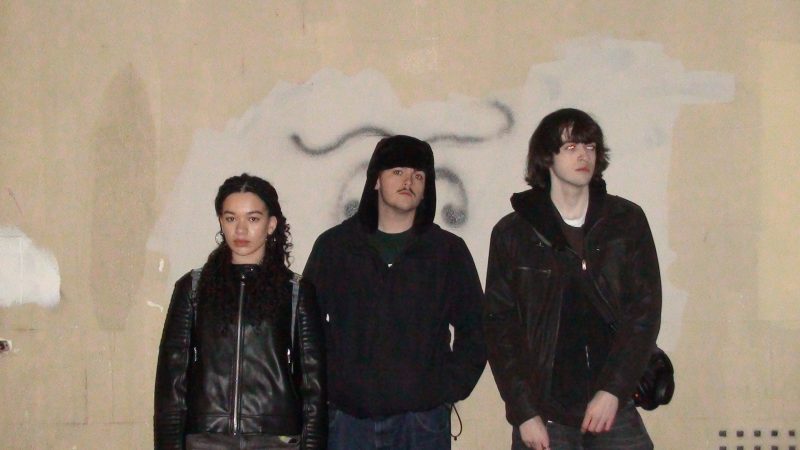
We catch up with the Newcastle-based Witch-House trio about their self-titled EP
Nadine Hurley recently dropped their self‑titled debut EP, with a limited cassette run via Katpis Tapes. One of the most ferocious new acts in the North East, the trio — Alex, Byron and James — channel the chaos and sharp humour of their live shows into a release that swings between witch‑house, hard techno, glitch‑scarred noise and scorched‑pop energy. The EP moves from the crackling, fuzzed‑out intro into the hypnotic pulse of Serenity, before Dreamer jumps from haunting organ lines to full‑tilt synth mayhem. Twin Peaks fires off a throbbing, laser‑seeking techno hit, and the outro drifts into chilled hip‑hop textures that grow more ominous as it unfolds.
It’s a heavy, high‑voltage listen without tipping into full darkness, and its constantly shifting dynamics keep everything sharp and unpredictable. Alex’s vocal sits deep in the mix, adding grit and grounding while each track veers off in its own direction. The result is exciting, inventive and genuinely thought‑provoking.
We caught up with the band to find out more about them and their new release…
How did the band get together?
Completely by faith, to be honest. Nadine Hurley was initially formed in late 2023 and was originally going to be a sasscore project with Alex and a couple of friends. After a couple of rehearsal and jam sessions, one of the guitarists and the drummer dropped out, so Alex put a post up on social media in early 2024 looking for people who would be interested in joining a project with influences that were complete contradictions of themselves, such as Metz, Death Grips and witch house bands like Crim3s.
Byron saw this and sent me a message, and we bonded over our love of witch house and hardcore rave music. After this we decided that Nadine Hurley would be a fully electronic band.
Byron and James are longtime friends, with Byron introducing him to me and his music in early 2025.
After being put on the same line-up as James’ solo project neverend4U in September 2025 and watching him live, we decided that he was exactly what we were missing and looking for in the project. We asked him to join the next month and the rest is history.
Where did the name come from?
We are named after one of Alex’s favourite riot grrrl bands, Skinny Girl Diet, and of course from Twin Peaks.
What are some of the biggest artistic influences on your sound?
Our sound is always evolving. We take a lot of inspiration from bands such as Death Grips, Burial, Jane Remover, Crim3s, ATR, Salem and Crystal Castles.
Witch house as a genre traditionally tends to be slower and more melodic, and with our music we almost flipped the narrative on what tends to be “stereotypical” witch house, incorporating techno and hardstyle beats into our music while still having the foundations of the witch house genre.
Your debut EP captures the chaos and intensity of your live shows — what was the biggest challenge in translating that energy into a recorded format?
Trying to stay still. Our live shows are usually quite chaotic, so at first we found it quite hard to translate this into our recordings.
We are very much DIY with how we do things and how we record. Everything was recorded in Alex’s living room over the space of three rehearsals. Alex also received a noise complaint letter from the council since we rehearse from home, so we knew that when recording we would have to be quick and also not too loud!
Typically when you record with a professional set-up everyone kind of just stands still and doesn’t really get into it. We are all about having fun, so while we were recording we just acted as if it was a regular practice or playing live. We all really got into it as we usually do, and we were just genuinely having a good time doing what we love most: making art we love with people that we love. You can really hear that in the tracks.
The press release paints a world of witch-house, glitchcore, drill, darkwave and metal all colliding at once. How do you approach blending these genres to create your own sound?
We think our approach to blending these genres mostly comes unintentionally. Most of what we try to make is usually just what we listen to put through a lens of what “witch house” is supposed to be. This is why a lot of the music we make feels like everything all at once.
With this project we want to make music that hasn’t been made before, and in a genre that has sometimes been shamelessly copied time and time again, it’s almost necessary to take from a large array of different genres.
There’s a strong sense of storytelling and world-building across the EP. What kind of universe were you trying to create with these tracks?
Our songs explore various topics such as religion, grief and non-conformity. However, applied to different contexts, certain songs can relate to different situations it depends on what side of the bed we woke up on that day.
Our second track “Serenity” is based around Philippians 4:6-7, which Alex often heard a lot growing up in a religious household, and the Serenity Prayer often used by 12-step programs such as AA. This song explores how faith can be a beautiful thing in the right hands, and that despite how you may feel in the moment, things will always work out in some form.
Religion is a funny thing, but we believe that you should always have faith, whether that is in something or in yourself. This song explores that.
Your sound is described as summoning “un/familiar creatures” and “Lots of ’Salem”. How much of your work is rooted in horror aesthetics, and what draws you to that space?
The fear of the unknown and uncertainty is something that draws us to this space and inspires us. We don’t know what will happen a day, a week or a year from now. We live in the moment because you never know what might happen.
Aesthetics-wise we take a lot of inspiration from late-2000s and early-2010s Tumblr and the nostalgia of that time, which feels very present again now. People are always searching for a sense of familiarity.
Alex’s vocals are framed as “submerged” rather than emerging — how intentional is that approach to voice-as-texture rather than voice-as-centre?
Alex takes vocal inspiration from a really wide range of vocalists, such as witch house pioneers like Kendra Malia, Heather Marlatt and Sadie Pinn, and digital hardcore vocalists like Alec Empire and Nic Endo of Atari Teenage Riot. A lot of the processing required the vocals to be almost submerged, as we thought of the vocals more like a guitar in some ways. not just vocals, but more like another instrument.
Tell us about the cassette release on Katpis Tapes.
We are doing a limited run of cassette tapes through our good friend Richy’s label, with the first postings out on the 21st of March.
What do you hope listeners feel when they hit play?
Something. We like to think of our music as immersive. We want our music to encapsulate a certain type of audience — we don’t want to be background music.
