
Narc. Magazine Online
Reliably informed

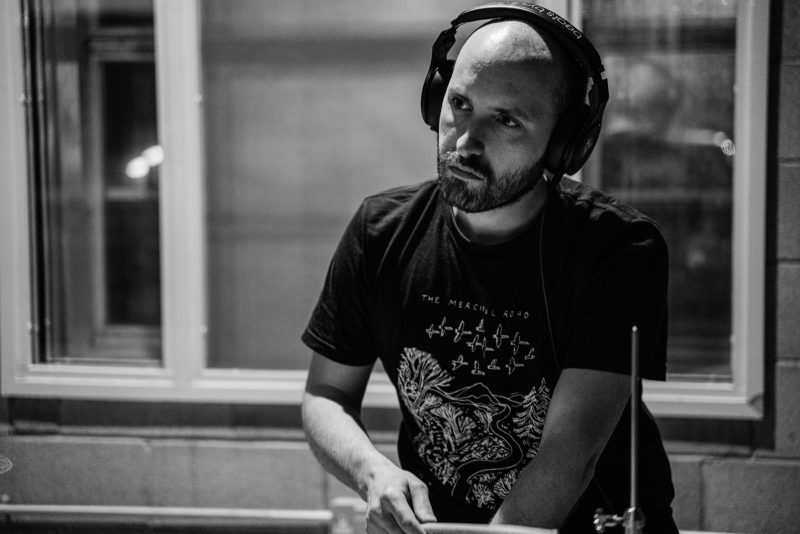
We chat to North-East composer George Patrick who has released A Weave That Wears Itself Out, a seven track EP of instrumental contemporary classical and jazz
North-East composer and performer George Patrick releases a seven-track EP of instrumental contemporary classical and jazz pieces called A Weave That Wears Itself Out. Produced by Matt Walch. The EP’s rich, resonating keys, ponderous rhythms and evocative ambience carry you through a vivid sonic journey — from the meandering, haunting pull of Ode to the Dog, to the hypnotic ivories and pop‑leaning punch of Development, before settling into the fragile, dancing piano lines of Resolution for Right Hand.
We catch up with George to find out more…
What first drew you toward composing and performing music?
I’d been lucky enough to have music lessons from when I was about 8. It started with piano lessons but my teacher moved away. She was so nice, I was too scared to try another teacher. Instead, I started learning the French horn at school with a brilliant and fun teacher called Mr. Hignett. A few years later I got my hands on a tiny electric drum kit and a keyboard that had a multi-track recording feature. I’d spend hours experimenting and loved how you could create a feeling and mood by just layering up notes and rhythms. I started to get more into drumming, took up lessons with the incredible teacher Geoff Hutchinson, and friends started asking me to play in their bands – “The Hot Rocks”, “Smoking Gunz”, “The Stars and the Sluice”, “Dirty Tricks In Middle England”. The rehearsals with those bands and numerous gigs at friend’s parties, local pubs and village halls are some of my fondest musical memories. Creating and performing music wove itself into my DNA and sense of identity. I struggled with my sense of self-worth growing up (as a lot of teenagers sadly do) but music took me away from the dark and gave me direction, purpose, joy, and connection with others.
Who were some of your creative influences growing up?
As a child, my main memories of experiencing music was on long car journeys. We’d all be at the whim of whatever my mum and dad wanted to sing along to. Eurythmics, Simply Red, Brand New Heavies, The Commitments being my most vivid recollections. There’s some absolute classics in their repertoire…
But when my brain was “switching on” to music and looking for its own identity it was Nitin Sawhney first. He had a big impact on me growing up. The breadth of his compositional ability is astounding. I couldn’t believe one person wrote all this music. He’s been able to absorb so much from so many different styles and genres and create such bold and innovative compositions. His albums have so much substance and feeling. “Beyond Skin” is one of my all time favourites.
I was also hypnotized by the immense groove of Jamiroquai – there is power in the delivery of notes played with feeling and conviction. It doesn’t have to be complex to move. I remember spending countless hours trying to learn how to play “Travelling Without Moving” on the drums. I still can’t get close to Derrick McKenzie’s deeeeep pocket groove.
Then I heard Nick Drake. And cried. For days. I’ve yet to find a voice that moves me in such a way (Joni Mitchell has come close) – he makes you feel how he is feeling. It opened my ears to the power of music to communicate emotion and mood. It truly is magic. “River Man” – my word. The lyrics. The string arrangement. The depth in the harmonic structure. The rolling rhythm of the 5/4 time signature. The way his voice breaks. I’m welling up just remembering the song, let alone listening to it.
When I was 17 a band mate lent me “Seven Days of Falling” by the Esbjorn Svensson Trio. I’ve never bought an entire band’s back catalogue as quickly. It was jazz like I’d never heard it. They were songs but not songs, it was jazz but not jazz, drum and bass, minimalism, maximalism, groove, ebb, flow, space… My favourite moments were the short piano solos dotted around the albums – the comparatively paired back delivery of truly astounding compositional ability and musical performance. Whole albums felt like entire compositions, chopped up but one thing.
Briefly describe your songwriting process.
All my compositions so far have grown from the piano up. I’ll work out a chord progression and rough structure that makes me feel a certain way then play it into my computer. From there I’ll work out how to present the chords whilst I play the drums along with it – I’ll try it out as different tempos or time signatures, chop it up, loop bits, take bits out etc. until I find the groove and structure that feels natural. At various points along the way I’ll add melodies or sometimes they appear naturally as a result of trying different things out. It’s like I’m discovering the piece as I go. Then I’ll add overdubs and see if they add to or detract from the mood or feeling I’m trying to convey.
Tell us a bit about A Weave That Wears Itself Out. How would you describe it sonically?
Real and natural. The acoustic instruments are always at the forefront. You can hear the physical instruments as well as all the notes. None of the pedal squeaks, key clicks, snare buzzes etc. were cleaned up. Any synthetic or engineered sounds sit in the background and bolster what’s happening up front. And none of it is quantized, the delivery of the music is natural and human. You can hear imperfections in note placements. All these add up to the music sounding human, real, played and felt – hopefully.
Where did the name come from, and what does it mean to you?
It is taken from a Roland Barthes book. The full quote is “…a weave that wears itself out catching itself up…” He is talking about how the spoken word cannot be taken back, only added to, creating a constant stream of addition and tweaking, a never ending discourse. Music is the same. Every note, every song, every release, every performance adds something new. Something new that can’t be taken back – it now exists. You can’t “un-say” something. You can say “I’d like to take that back” but all you’ve done is added more to the conversation. The title, to me, represents that feeling of taking the plunge and finally contributing some of my own music to the wider musical landscape, knowing full well it can’t be taken back. My compositions have been sitting on hard-drives unheard – some for over a decade. They’re out there now, I can’t take them back. I’m glad.
As an instrumental release, were there any visuals, moods or narratives guiding the writing?
Yes, but usually the mood or narrative would show itself during the writing, not before. I didn’t intend to write a piece about anything specific. But as I was working on it, a mood or narrative would start directing where I took the piece. “Ode To The Sleeping Dog”, for example, only became about the loss of our beloved greyhound, Atwood, when I wrote the final melody. There was something about it that made me think of how much I missed him. We lost him suddenly. The rug pull ending was the only way to finish it.
The only exception to this process was “Leave It In The Lung” – that was written during covid lockdown. My friend Mark came up with a brilliant idea where he’d send me a photo to use as stimuli for a composition. But I’d only have 24 hours to write it. A fun challenge to keep the mind occupied in troubled times. He sent me a beautiful photo of a frozen tree in bright sunlight. It reminded me of the scans you see of blood vessels in the lungs. The up/down motion of the piano motif represents the in and out breath. The short staccato chords at the beginning mirror anxiety, panic, worry. The composition eventually opens out into long, spacious, chords that don’t fully resolve. They could theoretically cycle round forever. Acceptance. Peace.
What’s something you learned about yourself while making this EP?
Music doesn’t have to be perfect. I thought I knew this beforehand but when it’s my name up in lights I found it hard to record a take and be happy with it. I’ve always performed and recorded with other people before and the main focus was always “is everyone else happy with what I’m doing?” and if they were, that was enough for me. I put the responsibility of attaching emotionally to the music on them. For my own material, that I’ve been working on behind the scenes hidden away, I turned into a perfectionism monster. It had to be perfect. But it never was to my ears. So I had two options: never share anything or bite the bullet and commit to a take and move on. Choosing the latter was transformative. It took time but I started to accept two things: good music is good because it moves the listener, not simply because the notes are exactly in time with perfect dynamics and delivery. And two, those “imperfections” imbued within a musical performance are what gives a musician their own unique musical fingerprint. I never thought I had a fingerprint; that was reserved for the musical greats. But actually, every musician has one. Including me.
You worked with producer Matt Walch — what did he bring to the project?
An incredible attention to detail and a seemingly limitless wealth of expertise and knowledge. Big words I know but he really is that good. He’d set up multiple mics in many different positions and we’d spend hours isolating mics and blending them to find the perfect sound – it had to be right. That degree of attention to detail can be heard in how beautiful the whole EP sounds. He brought vision and effort.
I’d describe, in vague wishy washy terms, the sound of a background drone or shimmering synth and he’d know exactly how to get it. And then help program and build those layers. He did all the mixing and mastering too. In short, it wouldn’t exist without him. I tried to record some of this stuff myself beforehand and it sounded kind of dead and messy. But he was able to bring it to life and give it a sonic identity. In fact, he’s the person that encouraged me to record it all in the first place! I’d been sending him short demos for years to see what he thought and he’d always reply – “sounds mint, let’s record it”. I’m glad I finally took him up on his offer. Not only because of the end result but how much fun we had in the studio. I love working with him. We laughed so much. I can’t wait to work with him again.
What do you hope listeners take away from the EP?
I hope it takes people on a journey through different emotions and responses. For me it’s a blend of melancholy, acceptance, peace and hope. Not necessarily in that order and often cycling back to other moods and flitting between two or more feelings at once… Reactions will differ from listener to listener and that’s one of the best things about music: your response is personal to you and just as valid. So I’d probably be happy with any response honestly.
Anything else on the horizon for you?
More recordings for definite. I’m currently working on about 6 compositions that will form the basis of the next EP. Hopefully it’ll all be written by summer so we can get recording in autumn. I’d really like to get out there and play the pieces too. Logistically it’s tricky as my coordination isn’t good enough to do the piano and drums at the same time. I’d need at least three more limbs. I could pair up with a drummer or pianist perhaps. There are a few musicians I have in mind that I’ll approach soon…
