
Narc. Magazine Online
Reliably informed

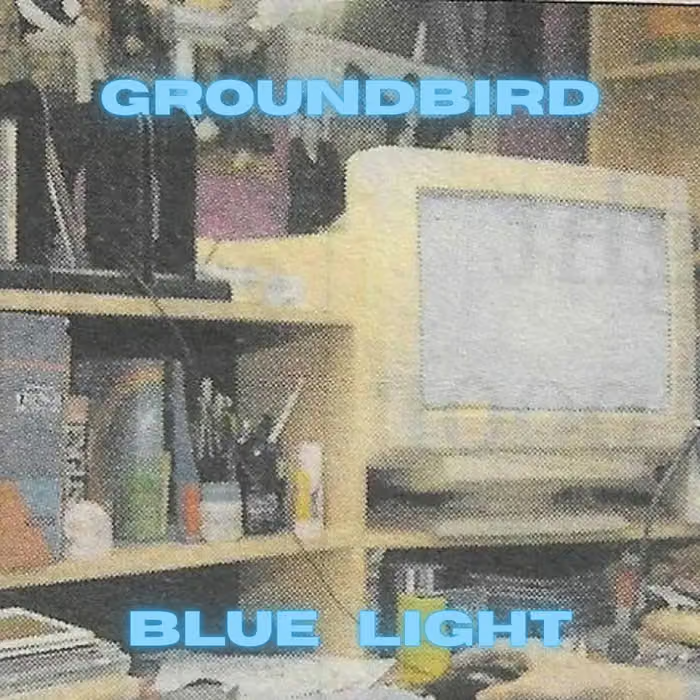
The indie singer‑songwriter talks us through the inspiration behind their new collaborative album
Groundbird returns with Blue Light, a crunchy, lo‑fi indie‑rock album that digs into the strange, jittery experience of growing up alongside the early internet. Written by South Lincolnshire‑raised songwriter Richard T. O’Brien, the album is influenced by The Wave Pictures, Half Man Half Biscuit and Cheekface and turns modern digital life into sharp, self‑aware indie: songs about microplastics, technological acceleration, Criterion Closet spirals and the constant glow of your phone while the world burns quietly in the background. The album was recorded at Harbourmaster Studios in South Shields, with home‑recorded fragments woven in and a cast of North East collaborators including Nev Clay, Sam and Eimear Covill, fiddle player Niles Krieger and Glastonbury Emerging Talent winner Bridie Jackson.
The record filters coming‑of‑age memories through dry humour, fizzy guitars and a worldview shaped by dial‑up adolescence. It opens with the lo‑fi, Elvis‑tilted swagger of Village Baby, moves through the melodious shine of Poison Damage, and settles into an understated, often hypnotic, lyric‑rich journey — from the synth‑rolled drift of Clown College Dropout to the crunchy, Lou Reed‑esque title track, the dark, shape‑shifting country‑folk of The Owl, the contemplative pull of Posting In The Dark, and the grungy, full‑tilt closer Bag Of Holding.
Here, Richard tells us more about the inspirations behind the album…
My new album, Blue Light, draws heavily from the well of British indie-pop artists who look for moments of joy and meaning in the crappiness of the everyday. I’m thinking here of Darren Hayman’s Pram Town, which describes growing up in the planned community of Harlow, Essex, with the wistful hook ‘I’m from nowhere,’ and of the Wave Pictures, whose song, Friday Night in Loughborough, was so important to me as a teenager, making me realise it was possible to write songs about small-town life in the East Midlands and still make them sound like proper rock songs about places that were actually exciting. I grew up in a little village called West Deeping, and the opening track here is a look back at that place in the style of Dylan’s Highway 61 Revisited. The song is partly about how little attention I was really paying to these potentially idyllic rural surroundings as a teenager, and that’s borne out for the fact that in the chorus, which lists the four streets of the village (and which I suborned various North East all-stars to list off with me as a kind of gang chant), I actually got one of the names wrong. My mum’s on it too, though, and she didn’t correct it either.
Some of the album goes through the touchstones of a 90s English childhood – Dave Benson-Phillips appears in the role of a twisted St. Peter, guiding local headmasters into Hell on Gunged – while at other points I’m looking at the weirdness of the world around us now. The Owl, written in the style of French chanson but with big, freak-out fuzz choruses, is about a group of excitable lads who go axe-throwing together after work and then decide to glass somebody for no reason in a bar built into a converted industrial space. Police Dog is a slightly feral garage-punk song about how I think it’s maybe not cool that we make animals into agents of state power, and Bag of Holding is this mad durational drone-type-thing about taking stock of all the cultural detritus you build up in your head over half a lifetime: ‘Clare Short and Clare Balding go into the bag of holding’ (among others). Another big influence here is what it does to your brain to live partially (increasingly?) on the internet for twenty years – the kind of ephemera you come across, stupid memes, going to sleep with horrific world news two inches from your face. But I could never have made the album without meaningful real-world community, and contributions from Sam and Eimear Covill, Niles Krieger, Nev Clay, Bridie Jackson, Gary Lang, Simon Kemp and Dogman Whistle all make the ramblings of a terminally-online millennial more fleshed-out and hopefully pleasant to listen to. And if you don’t agree, you can always drop me in the gunge.