Narc. Magazine Online
Reliably informed

Graham Dolphin discusses the ideas driving his latest exhibition, made with students from Durham Sixth Form Centre and shaped by Nirvana’s role as a sharp lens on culture’s tangle with capitalism.
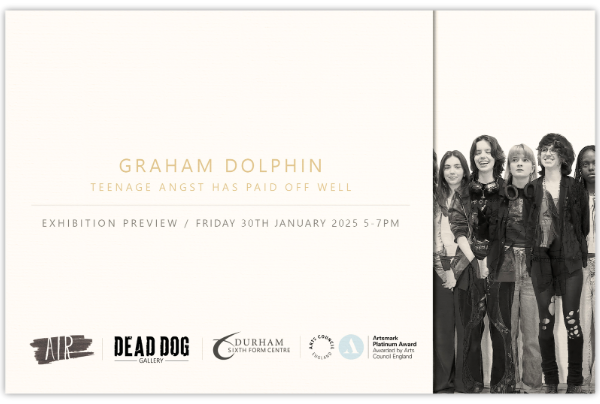
Visual artist Graham Dolphin returns to the North East this month with Teenage Angst Has Paid Off Well, a new exhibition at Durham’s Dead Dog Gallery (Preview 30 January 2026, 5-7 pm/exhibition 5th February – 20th March). Created during a residency at Durham Sixth Form Centre, the show brings together collaborative works made with students, new photographic pieces and selected earlier video and drawing works.
Titled after a line from Nirvana’s Serve the Servants — a band long woven through Dolphin’s thinking — the exhibition digs into the band’s rise, Cobain’s death and their transformation into a global brand, using Nirvana as a lens on the knot between culture and capitalism. Dolphin pairs past and present: thousands of Nirvana T‑shirt resale images sourced from Vinted, a filmed portrait series with students, and a one‑night performance from student band YAWNDOG at the opening all speak to his multidisciplinary, ever‑curious approach.
Here, Graham tells us more about the inspirations behind the exhibition…
The Durham Sixth Form Centre’s Artist in Residence programme is unusual in that it is embedded directly within the college’s visual arts department. The artist works alongside students day to day, using the college’s excellent facilities, with outcomes ultimately presented in the on-site Dead Dog Gallery. For me, the residency offered a rare opportunity to make work in close collaboration with students from across the entire college, allowing process, dialogue and exchange to sit at the centre of the exhibition.
The exhibition title, Teenage Angst Has Paid Off Well, is taken from a lyric in Nirvana’s Serve the Servants — a band that has long been pivotal to my thinking. From first seeing Nirvana perform in 1991, through their rapid rise to fame, Kurt Cobain’s suicide, and the band’s subsequent transformation into a global brand, they represent a compelling case study in the ways culture and capitalism intertwine. Nirvana sit at the intersection of authenticity and commodification, revealing how rebellion, resistance and subculture are absorbed, repackaged and sold back to us.
The exhibition investigates what remains of the idea of teenage rebellion today, and how it is expressed through fashion in an era where its visual tropes are instantly accessible and endlessly reproduced on every high street. Portrait of a Student Body is a filmed portrait series capturing students standing under studio lights against stark white backgrounds. Stripped of context, the portraits hold moments of awkward self-awareness: teenagers caught mid-process, forming identity, style and belonging. These images become markers in time, preserving the trainers, hairstyles and band T-shirts used as expressions of self.
With a vibrant performing arts community at the college, it felt essential to bring those talents into the exhibition. A one-night-only band was formed, named and given an identity by fellow students, YAWNDOG will perform a setlist spanning Nirvana, Wet Leg, The Ramones and Buzzcocks — blurring generational boundaries and highlighting how the fixed points of pop and rock history now exist as an open archive to be remixed and reimagined.
Alongside these collaborative works are photographic and video pieces that focus on consumerism, authenticity and expression. Over the last 12 months, I have been collecting images posted on Vinted of pre-loved Nirvana T-shirts listed for sale. The work presents 500 of these accidental photographs, many of which include glimpses of the sellers’ lives: cluttered bedrooms, wardrobe doors, bare feet. These peripheral details form strange, unintended portraits — lives glimpsed at the edges of the lens. Collectively, the images speak to the mass reproduction of rebellion as aesthetic, raising questions around fast fashion, environmental impact, the commodification of subculture, and the shifting role of photography in the era of the phone camera.
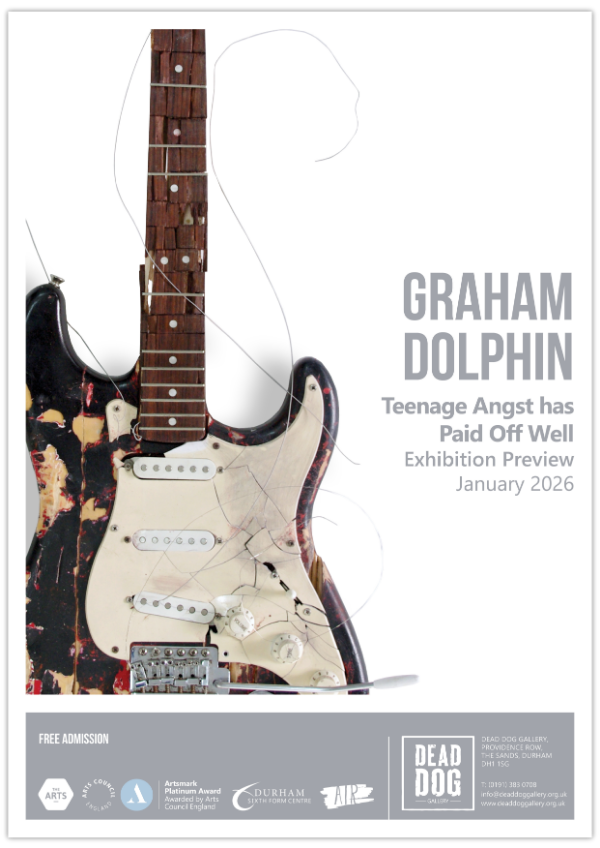
In the final room, I am presenting 660 Hits (2016), a performance to camera in which I attempt to destroy an electric guitar by repeatedly smashing it against the floor. Rather than the dramatic, instantaneous gesture associated with rock mythology, the act is extended to an absurd duration. Over more than half an hour, the guitar is slowly reduced to fragments. The dislocated sound of destruction and the growing exhaustion of the performer can be heard from the downstairs gallery, with visitors encountering the sound before discovering its source. This destruction is later reversed: the instrument is painstakingly reassembled and suspended from the gallery ceiling, hanging like a carcass — an object caught somewhere between ruin, devotion and ritual.