
Narc. Magazine Online
Reliably informed

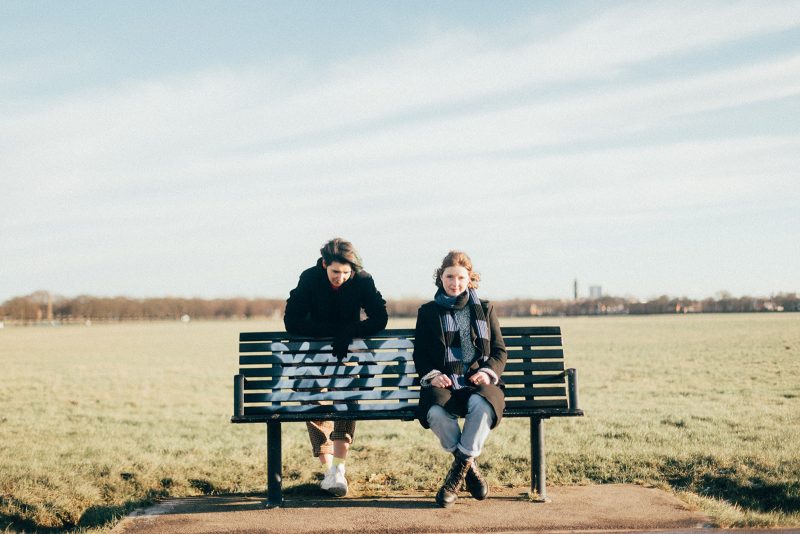
The genre-busting accordion and drums duo tell us about their self-assured second album, Repeat For Joy
North East duo ATFK—Amy Thatcher and Francesca Knowles—return with Repeat For Joy, a bold and innovative second album. Recorded with Field Music’s David and Peter Brewis, the seven-track release sees the genre-busting accordion and drums pairing dive deeper into experimental forms, gnarly synths and off-kilter grooves. Moving further from their folk roots, with nods to Three Trapped Tigers, Anna Meredith, ‘70s prog and ‘90s rave, the project explores themes of escape, renewal and emotional release.
A psychedelic opening drone on Intro gives way to the straight-up accordion sounds and riding rhythms of Swagger Back, which descends into a swirling soundscape of ’70s Who-esque delayed synth and ominous tones—from which the duo emerge victorious. So Far keeps things lounge-style, incorporating a receptive organ hook and stellar synth sounds amidst tidal-like crashes and musical merriment. The spacious simplicity of As One, with its heavenly vocal harmonies, brings things down a notch before Ever Love Lasting—with its retro-tinged ambient electronics, clap percussion and intimate, yet animated vocal phrasing—leads into the title track Repeat For Joy, where shimmering accordion, ’70s prog guitar, spoken word and ’90s R’n’B collide. R:emote, a slow-building piece of electronica expansiveness and jazzy jamboree, brings proceedings to a close. It’s a well-put-together, finely produced album that flows effortlessly from track to track, introducing new sounds, dynamics and intensity along the way, while anchoring the listener to the distinct and impassioned playing of Amy and Francesca.
We caught up with ATFK to find out more…
Give us a brief summary of your genesis and journey so far.
We started jamming together in late 2021, when multiple lockdowns had us longing for new projects and an outlet to make new music with people. Amy had written lots of tunes for solo accordion and had decided the project would benefit from working with a percussionist. Over the next year, it became less of a solo project and more of a duo, and the compositions developed as we added more drums, keys, synths, vocals… In 2023, we released our debut album ‘Emergency of the Female Kind’ and toured it around the UK, and in 2024 we performed at English Folk Expo and Manchester Jazz Festival, as well as other festivals, headline gigs and support tours, including Grace Petrie’s UK tour. This year, we recorded our second album, ‘Repeat For Joy’, produced with David and Peter Brewis of Field Music, for which we’ve ventured further down the path of experimental electronics and progressive composition.
Who are some of your musical influences?
Composers like Anna Meredith definitely had an impact early on, and we’ve found jazz-adjacent bands like Three Trapped Tigers, GoGo Penguin and E.S.T to be inspiring, as well as contemporary folk groups like Lau and Flook. WILLOW’s latest album had us both completely hooked, and we’re always listening to new alt-pop/ jazz. We especially gravitate towards music that pushes the limits of genre or boundaries in some way, things that challenge our expectations.
What has been your biggest musical achievement so far?
In 2023, we won the award for Fatea ‘Band/Duo of the Year’ among a shortlist of brilliant acts, and we’ve had some unforgettable gigs and showcases. But to be honest, our latest album is probably our biggest achievement to us, because it amounts to where we’re currently at, and we feel it’s musically more refined than the first – it’s nice to say we’re proud of what we’ve created.
You’ve played everything from folk expos to jazz festivals—how does your live show adapt across such varied spaces?
When we started this project, maybe because of the instrumentation, we thought it would be a folk thing, but then we found that we felt a bit out of place when we tried to play in more trad-folk environments, so we started to seek out opportunities in a range of genres just to see what happened. It turned out that a lot of people coming to these events are often seeking something new and different anyway, so we’d get people who came to folk gigs who like jazz, or came to a jazz festival but like math rock, or people at trad gigs being pleasantly surprised by something electronic, pop fans who didn’t know they like accordion… We used to tailor our setlist to fit in to more specific lineups – like choosing the more folky tunes and songs for folk clubs, or the heavier ones for rock venues – but as time has gone on we’ve started sounding more like ourselves, and we’ve become more comfortable with saying ‘This is what we sound like’; that confidence seems to have had a positive impact. Somehow not really fitting in anywhere has given us the potential to fit in everywhere.
Repeat For Joy explores themes of entrapment, escape and self-renewal—how did those ideas shape the writing and recording process?
In January 2024, we took ourselves away for a week to a remote cottage in rural County Durham and set up instruments and laptops in the living room and started writing new material, jamming and recording rough demos. We only saw each other and a few nosy sheep for the whole week. Undoubtedly, the landscape had an impact on tracks like ‘So Far’, which conjures up the vastness of the hills and the bleak weather, but also the solitary nature of tracks like ’As One’, and in a very literal sense ‘Remote’. That week we were escaping our everyday lives to be in a quiet creative space with no distractions. Amy wrote the lyrics during the last 2 years of her marriage – both sets of lyrics play with the need to endure entrapment and fantasise for escape, while the constantly changing pronouns shift blame and responsibility. The meaning of ‘Repeat For Joy’ as a title is twofold – the first is bitter resignation as this difficult cycle inevitably begins again; the other is more naïve and positive, based on our experience of music itself and the hope for our listenership, about finding solace in music and repetition.
When we finally came to record the full album, it was January again. We love using the quieter winter months as a chance to reflect, compose and experiment – it’s the perfect time to write new music as it’s often the only month of the year where nothing else gets in the way. I suppose this is what ‘hibernating’ often looks like for musicians.
You’ve described the album as a “joyful snapshot” of a cyclical emotional journey. What does joy mean to you in a musical context?
Joy for us is a lot of things. It’s hearing back what you’ve created for the first time, finding a satisfying sound in the studio, putting the finishing touch to a track that makes everyone in the room go ‘yeeeah!’. It’s locking in a groove while jamming together, finding a trick in the timing of a new tune, doing an unexpected thing together that really works during a gig, exchanging a glance with your bandmate that lets you know it’s all going as it should, or better. Seeing an audience completely engaged, and then hearing them cheer for something they never expected. Finding communities, connecting to someone else’s music on a deep and personal level. It’s knowing that even when this is hard it’s still the absolute best thing we could be doing.
Working with David and Peter Brewis of Field Music—how did that collaboration influence the sound or structure of the record?
Working with David and Peter was a total joy because they were so interested in what we were doing, and totally up for entertaining even the silliest ideas we were throwing at the wall. We’d already written the music almost a year before, but wanted to experiment with the palette of sounds a bit more in recording the final thing. We knew we had to make the drums a priority and Field Music’s sound has always put drums front and centre of the mix, so that was a great place to start. Every time we wanted to add another sound, like a synth or organ, we had a whole corner of the room to explore, like being in a synth playground. The detail in some of the sound design is also down to David and Peter’s openness and eagerness to experiment with whatever instruments and production techniques were available. The breakdown section in ‘Swagger Back’ is the result of messing around with a disjointed drum solo, which has ended up sounding more like thunder than drums, and the percussion sound in ‘As One’ is a combination of the sound of lifting the pedals on an old piano and clicking the buttons on Amy’s accordion. Every sound was given careful consideration and there were so many options available to bring it to life.
We also know that our act is especially strong as a live show, so we wanted to illustrate that ‘live energy’ across the whole album. All of the drums and accordion were tracked at the same time, meaning we both played together exactly as we would during a gig.
All four of us were involved in every part of the process, which I think made it feel like we were being supported throughout – no idea was too weird or too difficult to accomplish.
The album blends influences from prog, rave, and experimental electronics. How do you approach genre when composing together?
We’ve definitely found ourselves enjoying playing with prog-y and math-y ideas, but perhaps without always realising. The truth is, we never deliberately consider genre at all: we often start with a melodic idea on the accordion or piano, and then just aim for sounds, patterns, rhythms and textures that we’re curious about and see what happens. Occasionally that’s resulted in things that were too weird and we’ve had to pull them back to something more grounded, but mostly the way we compose is a case of combining fragments of ideas, like ‘What do you think of this motif?’ and ‘Shall we try something that sounds a bit like this or uses this phrasing?’ and ‘Could we create a noise that uses this acoustic sound combined with that electronic sound?’. It’s often about layering, and then deciding whether to keep it relatively simple or to keep building. And if all else fails, add a wailing synth!
How do you decide which tracks become singles from the album?
We usually get a sense quite early on of the ones that feel most exciting to play live, or just lock into place most easily. And sometimes we play tracks to our friends and partners and try to gauge their reactions. If there’s a bit that keeps sticking in people’s heads, it’s probably going to work as a single.
How do you hope audiences respond to Repeat For Joy—whether live or on record?
We love it when people get as nerdy about our music as we do making it. The ones who want to engage with it on another level, who close their eyes and let it wash over them, or feel entranced by it in some way. We love to be someone’s latest geeky discovery, and for them to feel a sense of joy and elation when experiencing. Or if they just want to count the beats and rush over to tell us about it afterwards, that’s also pretty funny.
What’s next for ATFK?
We’re fortunate to be on Jazz North’s ‘Northern Line’ roster this year, so we’re excited to get out touring. We’re currently booking gigs for February, and this will tie in with when we release the deluxe version of our album on vinyl, which involves a few exciting collaborations. So keep an eye out for new tracks and some live dates!
