
Narc. Magazine Online
Reliably informed

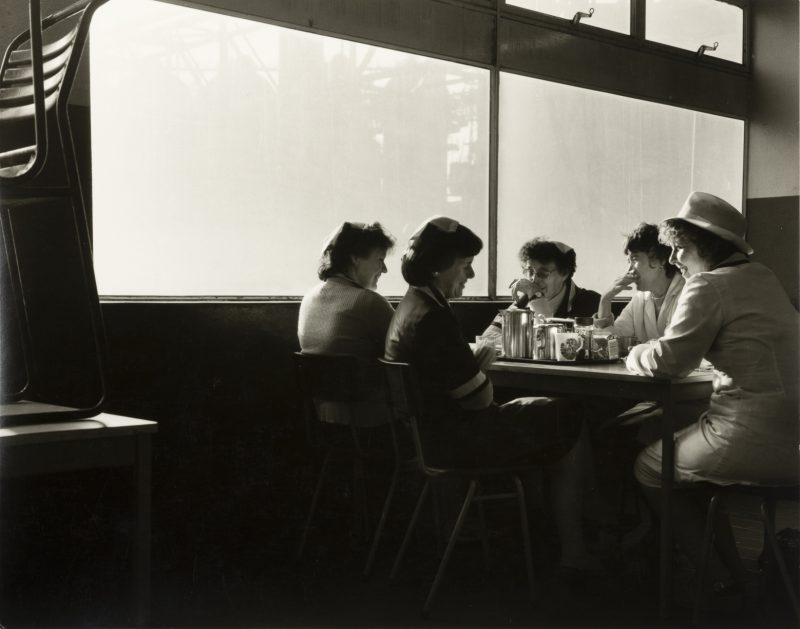
We catch up with the Cleveland-born artist and photographer to find out more about him, his work and Fixing Time – a retrospective exhibition taking place at Sunderland Museum & Winter Gardens and Northern Gallery for Contemporary Art
Photograph: Canteen staff catching up on the day at the end of their shift, Redcar blast furnace, Autumn 1983 by Ian MacDonald
Fixing Time is a retrospective exhibition across two venues – Sunderland Museum & Winter Gardens and Northern Gallery for Contemporary Art – exploring 50 years of work by renowned British artist and photographer Ian Macdonald.
Known for his unique style using traditional black-and-white film and print-making techniques, his career has spanned five decades and has documented life, the evolution of working-class communities, and the rise and fall of industry in Teesside and Cleveland.
Then exhibition is on until 3rd November at the Northern Gallery Of Contemporary Art and until 4th January at Sunderland Museum & Winter Gardens and unveils the lesser explored yet equally significant facets of his photographic practice, including previously unseen portraits captured in secondary schools across England over a span of 35 years, large-scale drawings, as well as other photographs, archival materials, publications, and videos, offering a deeper understanding of the artist.
The exhibition at Sunderland Museum & Winter Gardens spotlights key photographic series such as “Heavy Industry,” “Smith’s Dock Shipyard,” “Redcar Blast Furnace,” and “School Portraits” and the exhibition at Northern Gallery for Contemporary Art delves into other significant series like “The River Tees Estuary,” “Greatham Creek,” and “People, Towns and Portraits.”
We caught up with Ian to find out more about him, his work and the current exhibition…
What art/music/literature inspired you growing up?
Aged eleven whilst on holiday, from our home in Middlesbrough, to Whitby I encountered the photographs of Frank Meadow Sutcliffe, the great Victorian photographer. Those pictures in a shop window really gripped me. That would be 1958; eight years later I bought my first photograph, a Sutcliffe from a small house sale in Whitby; it still hangs in our hallway at home. Two years later I went to Art College. As for literature in my youth, Jack London had a big effect and Mark Twain with Huck Finn. I am very influenced now by the novel and short story writing. I try to create visual narratives through the way exhibitions are sequenced. With music, going into the school hall aged seven or eight, I strongly remember Holst and Mozart and Bach, but equally Elvis and the Beatles featured strongly in my early listening mind.
You’re trained as a draughtsman, was that your original career ambition?
Trained as a draughtsman does not mean technical drawing it means I studied drawing at Art College and have always had a strong interest in drawing as a means of understanding, say the landscape, and as a means of personal expression. Both types of drawing play an important role in the exhibitions at Sunderland.
How did you get into photography? How did it end up becoming your profession?
It is perhaps an odd thing to say but I do not see photography as my profession.
I taught in Secondary Modern Schools for twenty-eight years, six years full-time and the rest part-time. This provided a basic income from which I was able to be free to make the kinds of photographs I was interested in. I had small grants and awards, which part-funded what I was doing. I became interested in photography because the Art College I studied at, where I wished to be a painter, was almost totally conceptual in its outlook and teaching strategy. The photography department were more down to earth, though still working at drawing and painting, photography filled a role in allowing me to directly respond to what I was interested in through the camera.
Can you describe your first experience with documentary photography?
4 Two events made a huge impact on me in 1970/71. Firstly I saw an exhibition in Middlesbrough Municipal Art Gallery of the work of Bill Brandt. Organised by the Museum of Modern Art in New York, and visiting only two areas in Britain, I came away from that exhibition realising that photography could be visual poetry. Secondly and at about the same time I saw a programme on television about an American photographer called Bruce Davidson. He used a 4 x 5 camera on a tripod and photographed a typical street in downtown New York, 100 East Street. This equally had a profound effect on me. In another medium, Ken Loach’s film Kes equally moved me and sowed the seed of the importance of the ordinary in the everyday.
What about traditional black-and-white film and print-making techniques do you like so much and what does it bring to your work?
Of course when I began photography black and white was virtually all we had. Colour film was around but black and white predominated the teaching world.
I’ve stuck with it partly out of habit but more importantly its use, especially with 4 x 5, really slows you down. Standing behind a tripod also sets up a different relationship with both the landscape and with people being photographed. There is nothing quite like a 4 x 5 negative on the baseboard of an enlarger in a darkroom, the detail and the depth within the picture make these prints so special.
Who are some of your favourite photographers and why?
Amongst my contemporaries Graham Smith, Tom Wood, Chris Killip and David Wise all have had positive effects on my approach to photography. There are so many others historically, Doisneau, Strand, Brandt, Frank and further back both Sutcliffe and Atget have helped me along the way.
How can photography convey a message more effectively than other artistic mediums?
Pass – well it cannot. Each person’s expression is vital and the viewer of that expression takes their understanding of things to whatever they are viewing and that to them has a meaning. That meaning, to each of us, is what is important so nothing may convey a message more effectively, because we all differ from one another.
What qualities must a scene or situation have to make you want to capture it on film? How do you balance artistic expression with factual storytelling?
This is a truly difficult question to answer. My time away from my family is spent creating pictures in my head. Some time ago now I used to see a good photograph, and not having a camera I used to write up the situation as if
I had made the photograph. When I’m out working in a chosen situation, no matter where, I feel my way around, sometimes by making drawings in the place, at other times by walking around and simply being present. I do not go out looking for photographs to ‘take’ rather I attempt to ‘make’ photographs by putting myself in places I find congenial; this could be almost anywhere.
Can you share a particularly memorable or impactful moment you’ve documented?
One extremely cold, frosty night, with snow on the ground I made my way to the South Gare on the River Tees estuary near Redcar. The heavy industry around the estuary was always brightly illuminated and the snow, I felt, would exemplify this. On arrival, I was awestruck by the quality of the night light. Around midnight I made an exposure in the big camera on the tripod of the Redcar blast furnace looking along the South Gare road. I remember being struck by the small lights up the furnace structure looking, it seemed to me, like some star pattern, not unlike the constellation Orian, striding up into the night sky. I then made several exposures around the frozen lake, which at that time stood in front of the furnace. On making my way around the piece of water I entered the west of the blast furnace site. Here seemingly abandoned junk abounded covered with snow. This was exciting visually and I proceeded to make my way deeper into the site making exposures along the way. I finally stopped when I ran out of film, 24 4 x 5 exposures, in three or four hours.
Tell us about Fixing Time. What inspired this retrospective exhibition?
In late 2019 I held an exhibition in the Crossley Gallery at Dean Clough in Halifax. This was a largish exhibition. Vic Allan, the curator, made a wonderful tour catalogue; with having put so much work together we thought it may be a good idea to tour it. I dutifully sent the guide out with very little response. Later the NGCA had an exhibition of work from the Arts Council collection. This featured one of my photographs, which ended up being used as the poster for the exhibition. The poster received a good response such that it was suggested by a member of staff that perhaps an exhibition of the work of the poster photographer could be held.
Two curators from NGCA and Sunderland Museum visited Grosmont to look at work in the studio and I was offered an exhibition in both galleries to run concurrently. It was decided that the exhibition would feature my earlier work from photographs made around the hinterland of the River Tees estuary and East Cleveland.
The exhibition includes unseen portraits captured in secondary schools across England over a span of 35 years. Why have you waited until now to exhibit them?
I believe in this particular case you’re talking of the school photographs. During my teaching practice in Preston, I decided to make photographs to record what I was doing as a trainee teacher. This was in 1977. When I became a teacher and had settled into the job it struck me that the young people I was teaching were our future. These people had vitality and a sense of who they were and as such I began to make photographs of the qualities I felt they represented. I also realised the importance of the fabric of schools and integrated the ambience of the buildings into many of the pictures. The photographs in the exhibition were all made in the first school I taught in, in East Cleveland. I went on to photograph in a number of other secondary schools in Redcar, Middlesbrough, Eton, Normanby and Huyton on Merseyside. I’ve hardly shown these pictures before, partly because they never quite felt complete and partly because other bodies of work took precedence. Through curating these two exhibitions I could see the value of including examples of the school photographs into an integrated overview of my early work in photography.
What are some of your personal highlights of the exhibition?
Personal highlights of the exhibition are many but organising the two bodies
of work into a meaningful whole is high on the list. This, though time-consuming, was both useful and rewarding and has brought together elements of photography I’ve never exhibited together. I do feel going from one venue to the other allows for a more reflective appraisal of what is going on. This is greatly helped by the construction of walls within both venues. This allows for quite subtle separation of sections offering the idea of being separate but also part of a wider whole.
The exhibition also features detailed large-scale drawings, which often serve as precursors to your photographic projects. Can you elaborate?
There are two types of drawings within the exhibition. The drawings created around Greatham Creek in the early 1970’s are analytical, are concerned with gaining a deeper understanding of an area. They are not trying to be art; they use the tool of drawing to look harder at the landscape. This undoubtedly provides a deeper insight into the landscape thereby charging the imagination with more information when eventually creating certain types of photographs.
The other type of drawing is very different. These are far more personal and attempt to explore things that cannot be photographed. They use drawing rather as an extension of my mind trying to understand and give meaning to thoughts and feelings deep within my psyche, equally, these drawings are not trying to be art.
What do you hope those who experience your exhibition take away from it?
I do believe in the power of photography, in the way I use it, to stimulate memory.
It’s been great really to create these exhibitions. I hope they give people a chance not only to see my photographs, but also through seeing the photographs to reflect on their lives, because they’re looking at the work and of course what they take to the work is not the sum of my time – the pictures are the sum of my time – they’re looking at the pictures with what they take to them, the sum of their time, and the way the pictures are sequenced is about offering opportunities to reflect on their lives, their past, their time.